
S&P 500 and Nasdaq 100 plummet after statements from Fed officials: Nvidia loses 4%
Within 15 minutes, $500 billion evaporates on Wall Street. Fed officials hint at tighter policies, and tech stocks are taking a hit.
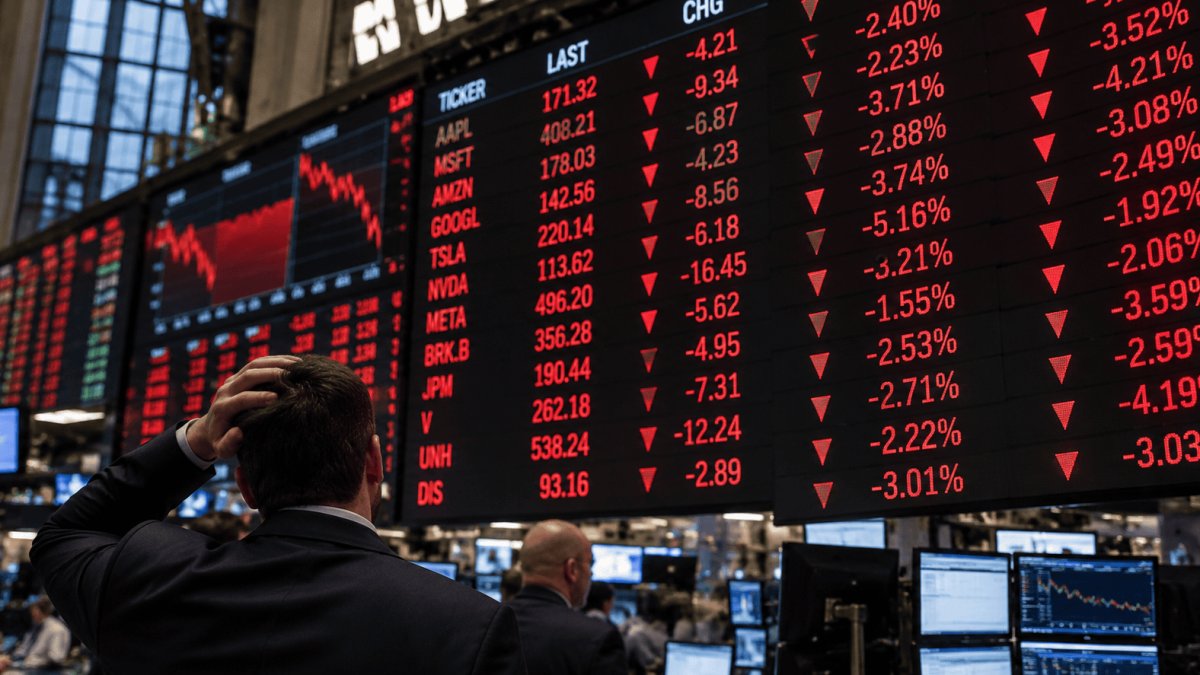
The U.S. stock market has taken a severe downturn. Both the S&P 500 and the Nasdaq 100 are showing deep red, even though the new inflation figures gave little reason for this.
The main reason for the downturn seems to lie with two central bankers who have sent clear signals that the Federal Reserve needs to take a tougher stance.
Within fifteen minutes of the opening bell, around $500 billion in market value had already evaporated. At the time of writing, the S&P 500 is down 1.18 percent, while the Nasdaq 100 is down as much as 2.26 percent.
Tech stocks are therefore taking the biggest hit, with Nvidia at the center of the sell-off. The chip king has fallen by 4 percent, after recovering nicely from a 14 percent drop caused by Jensen Huang's departure.
That departure still seems to be making the sector tremble, as investors are uncertain about the implications for the AI bull market.
Other chip stocks are falling even more sharply today. Broadcom is down 6.2 percent, SanDisk 8.2 percent, and AMD as much as 9.6 percent.
The major tech companies building the AI infrastructure are faring better. Meta is up 0.37 percent and Microsoft 0.10 percent, while Amazon is down 0.76 percent and Alphabet 1.36 percent. Apple, the most valuable company in the world, is up 1.18 percent.
The Nasdaq 100 chart shows significant damage. The index has once again dipped below its 200-day moving average, which is the average closing price over the last 200 trading days. Prior to that, it had just fought its way back after last week's collapse. There is still plenty of time until the closing bell, but there is a lot of work to be done.
At 2:30 p.m., investors received a slight reprieve in the form of lower inflation figures. The Producer Price Index (PPI) rose slightly less sharply than expected, but this was mainly due to energy prices. And on an annual basis, it is still at the highest level since November 2022.
Prior to this, the entire futures market was already betting on an interest rate hike next month, and nothing has changed in that regard. Only the group expecting a rare 0.50 percentage point hike has become slightly smaller.
The stock market initially made a small leap, but that was quickly reversed. Ultimately, Austan Goolsbee, President of the Chicago Fed, and Susan Collins, President of the Boston Fed, worsened sentiment again.
Goolsbee kicked things off by saying that the central bank “clearly still has work to do to continue restoring credibility.” Inflation has been above the 2% target for six years now, and Chairman Kevin Warsh has repeatedly stressed his commitment to changing this.
He also said that no progress has been made recently and that things are heading in the wrong direction. According to him, this is not only due to supply shocks in oil supply, but also to “old-fashioned” overheating caused by the construction of AI data centers.
Collins also said that this week's inflation figures came in “less promising” than hoped. On Tuesday, the Consumer Price Index (CPI) actually came in higher than expected.
She acknowledged that higher interest rates affect buyers and builders, but prioritized stable prices. Fed Chairman Kevin Warsh also previously stated that the focus is entirely on inflation, now that the labor market is showing strong figures. Yesterday, Beth Hammack, President of the Federal Reserve Bank of Cleveland, also warned that interest rates need to rise further.