
XRP volume surges 99% to $62M, yet small sellers lose out
In a static XRP-to-RLUSD model, the 100,000-XRP shortfall narrowed while smaller sales worsened and all three tested sizes returned fewer RLUSD. Read the full story on CryptoSlateUnderstand the crypto stories that matter and what to watch next. Get The Catalyst in your inbox
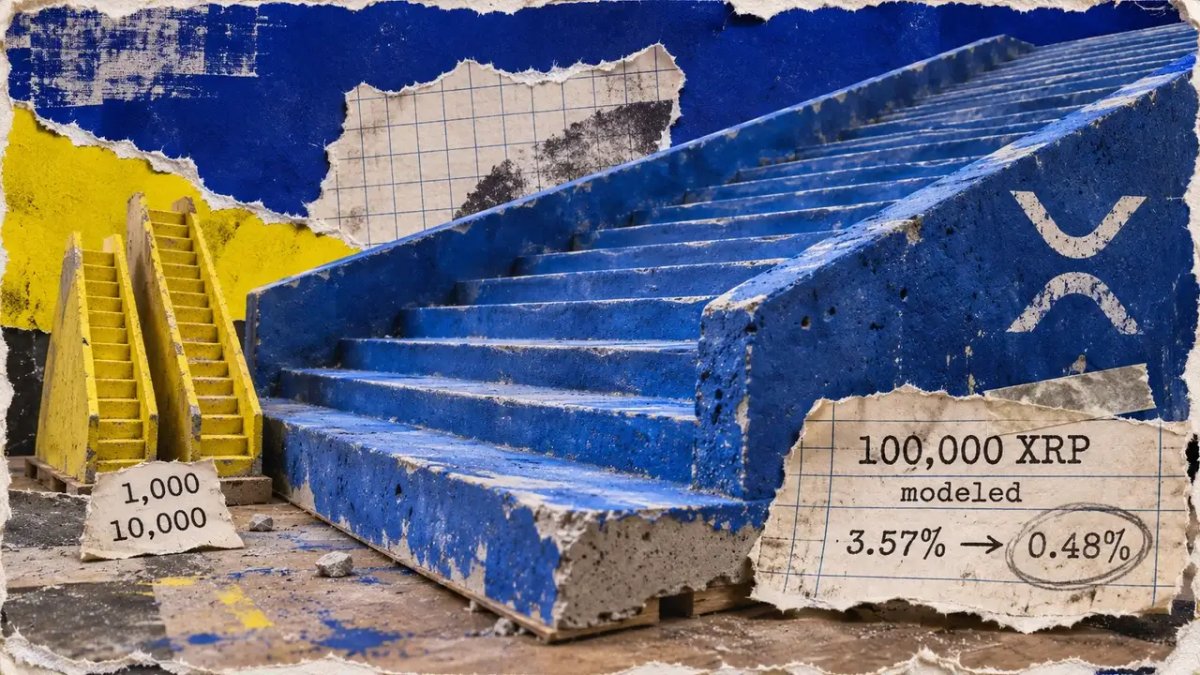
XRP-paired trading on its native ledger nearly doubled over Nov. 9-15, but a separate comparison of the direct market for Ripple USD (RLUSD) at two dated ledgers showed a smaller execution penalty for a 100,000-XRP sale.
DefiLlama's daily data put completed Nov. 9-15 trading at $62.6 million, up 99.9% from $31.3 million during Nov. 2-8.
The measure combines XRP-paired automated market maker swaps and order-book trades. Native XRP participates directly, but repeated turnover can recycle existing inventory without establishing fresh net buying.
NOSHASHI's ledger data showed the XRP/RLUSD automated market maker holding 2.165 million RLUSD at Nov. 9's close and 1.861 million on Nov. 16, a 14% decline. Native XRP in the same pool slipped from 1.972 million to 1.959 million.
Over that interval, sampled funded RLUSD offers available to token sellers increased from about 19,392 to 111,951 RLUSD, roughly 5.77 times the earlier amount. Funded amounts measure what the offer owners could deliver and may be below the advertised size.
NOSHASHI's measurement requests at most 100 offers per side and counts funded depth within 10% of each snapshot's reference midpoint. Its ask side is the RLUSD inventory an XRP seller receives, and the figures exclude AMM reserves, do not measure all XRP liquidity, and do not imply that every sampled offer sits near the best price.
Related ReadingAn idealized static model combined the Nov. 9 raw offers and pool state with their Nov. 16 equivalents. For each snapshot, it allocated XRP between funded offers and the constant-product pool according to which supplied more RLUSD for the next XRP sold.
The pool calculation includes its ordinary trading fee, 0.308% at the earlier ledger and 0.315% at the later one. XRPL can combine offers and AMMs in an actual transaction, but this calculation is not account-specific pathfinding or a completed fill.
The benchmark is the midpoint of the sampled book's tightest uncrossed bid and ask quotes, equivalent to about 1.098 RLUSD per XRP on Nov. 9 and 0.951 on Nov. 16.
| XRP sold | Nov. 9 modeled RLUSD | Nov. 16 modeled RLUSD |
|---|---|---|
| 1,000 | 1,097 | 950 |
| 10,000 | 10,973 | 9,488 |
| 100,000 | 105,867 | 94,600 |
In CryptoSlate's calculations, the shortfall for 100,000 XRP narrowed from 3.57% to 0.48% against each snapshot's own reference midpoint.
This compares modeled proceeds with the token amount implied by that reference price and includes spread, modeled AMM fees, and price impact. The lower absolute proceeds on Nov. 16 reflect XRP's lower price in RLUSD, despite the smaller relative penalty.
The smaller trades did not share that improvement: the 1,000-XRP shortfall widened from 0.05% to 0.11%, while at 10,000 XRP, it widened from 0.05% to 0.19%.
In the later snapshot, the larger modeled sale relied more heavily on funded offers. On Nov. 9, only about 17,701 XRP went to the sampled book, leaving 82,299 XRP for the pool. On Nov. 16, about 88,471 XRP went to offers and 11,529 XRP to the pool.