
Prediction markets have a major problem as most Americans reject betting on elections
Prediction markets want you to see them (and use them) as one of the best possible instruments for finding out what’s happening in the world. Open any election market, and you’re immediately given a probability that shifts in real time as people trade. It’s a single number, easy to check in a few seconds, that… Read the full story on CryptoSlateUnderstand the crypto stories that matter and what to watch next. Get The Catalyst in your inbox
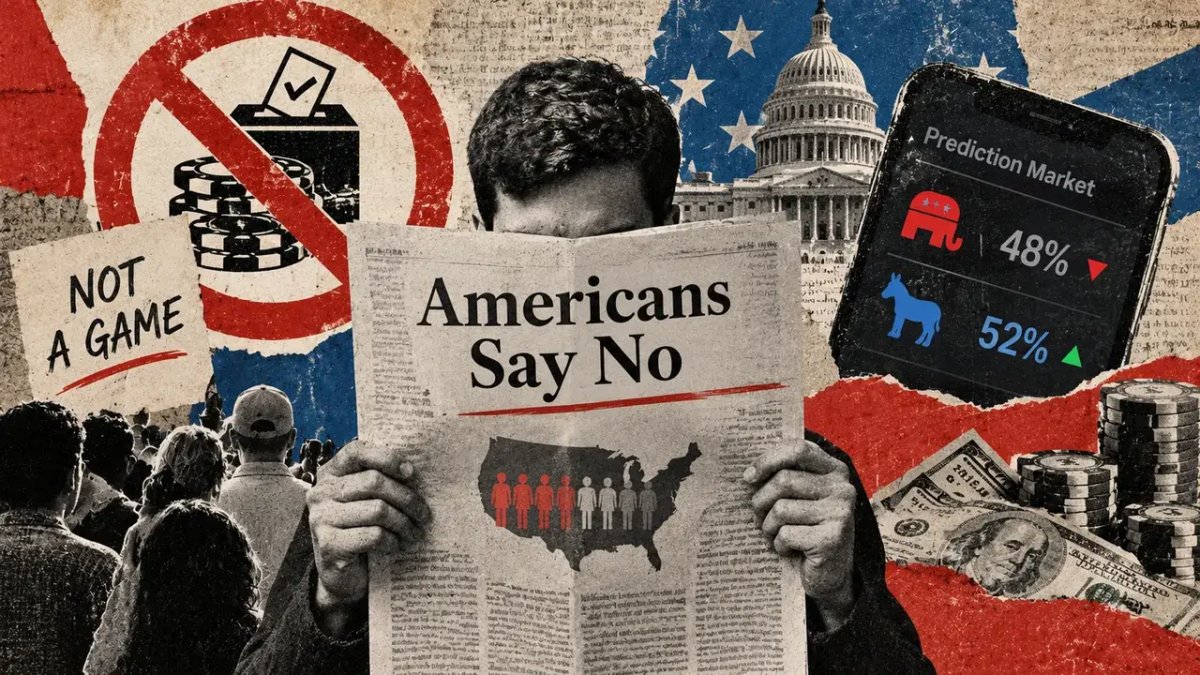
Prediction markets want you to see them (and use them) as one of the best possible instruments for finding out what’s happening in the world.
Open any election market, and you’re immediately given a probability that shifts in real time as people trade. It’s a single number, easy to check in a few seconds, that condenses something as uncertain and volatile as an election campaign into a number that essentially tells you the likely outcome.
That clarity is their main appeal, and it explains why so many people now treat these markets as a running scoreboard for the race.
The catch is that the number exists only because many strangers are wagering on who will govern you, a premise plenty of Americans now find pretty distasteful.
A recent Ipsos poll Reuters published found that 69% of Democrats and 61% of Republicans opposed using prediction markets to bet on election results. They also opposed using prediction markets to bet on other things, like military actions and government policy decisions.
The survey interviewed 4,506 US adults from Sept. 30 to Oct. 5 and measured approval of betting, so those answers don't show whether people trust the forecasts or which objections drove their views.
The results complicate the industry's favorite defense, which is that they produce better information. While accuracy is prediction markets' strongest card, it does nothing for the separate question of whether the bets behind those numbers should exist at all.
Voters can find election forecasts valuable and still object to a system in which the people who run elections, or influence how they’re run, can profit from the result. The poll shows that the industry's argument for better information isn't enough to win public support for election betting.
The industry now needs to defend both how it produces the number and how good that number is.
In a basic election contract, the winning side pays $1, and the losing side pays nothing. If you buy a candidate's victory at 60 cents, you make 40 cents if they win, or you lose your 60 cents if they don't.
The market prices that as a 60% probability, which simplifies it and makes it easy for everyone to understand and trade. Underneath that percentage, buyers and sellers commit money to their expectations.
Someone who thinks the candidate's prospects are better than the price implies has a reason to buy, while someone who thinks they're worse has a reason to sell or take the other side. Get enough of those trades, and it pulls the price toward informed judgments.
Because anyone can bet on prediction markets, you can get a diverse mix of participants, like people who actually support the candidate in question and people who just like to gamble. The odds you see on a market don't tell you which of them made the most trades.
Kalshi is trying to make that easier to see. Its Oct. 6 election update introduced low-volume labels and more prominent trade feeds, alongside scores comparing forecasts with outcomes.
The company also said something interesting: most of its traffic comes from people who watch rather than trade. That audience, the people watching the markets, is central to its information argument: relatively few people can produce a price that many more people see.
Prediction markets offer more than election-night entertainment, since the same contracts that give watchers a running forecast can also serve people with real money riding on a government decision.
Say a company stands to lose money if the government makes a particular decision, and it buys a contract that pays out when that decision goes against it. The payout can soften the loss, provided the contract’s wording matches the risk, and the traders on the other side of the bet simply expect a different outcome and have no business at stake.
That makes the market a good financial protection for those who need it, and it gives everyone else a forecast that's backed by real money.
But a voter that's just reading that forecast gets none of those benefits, and has no say in which events the platform chooses to list. Kalshi decides if an event is worth offering, then traders show up to bet on it, and the event becomes a product.