
US deposit rates choke USDC adoption, and a BIS model reveals why
Historical estimates point to stronger USDC growth sensitivity to deposit repricing, while exchange rewards complicate adoption forecasts. Read the full story on CryptoSlateUnderstand the crypto stories that matter and what to watch next. Get The Catalyst in your inbox
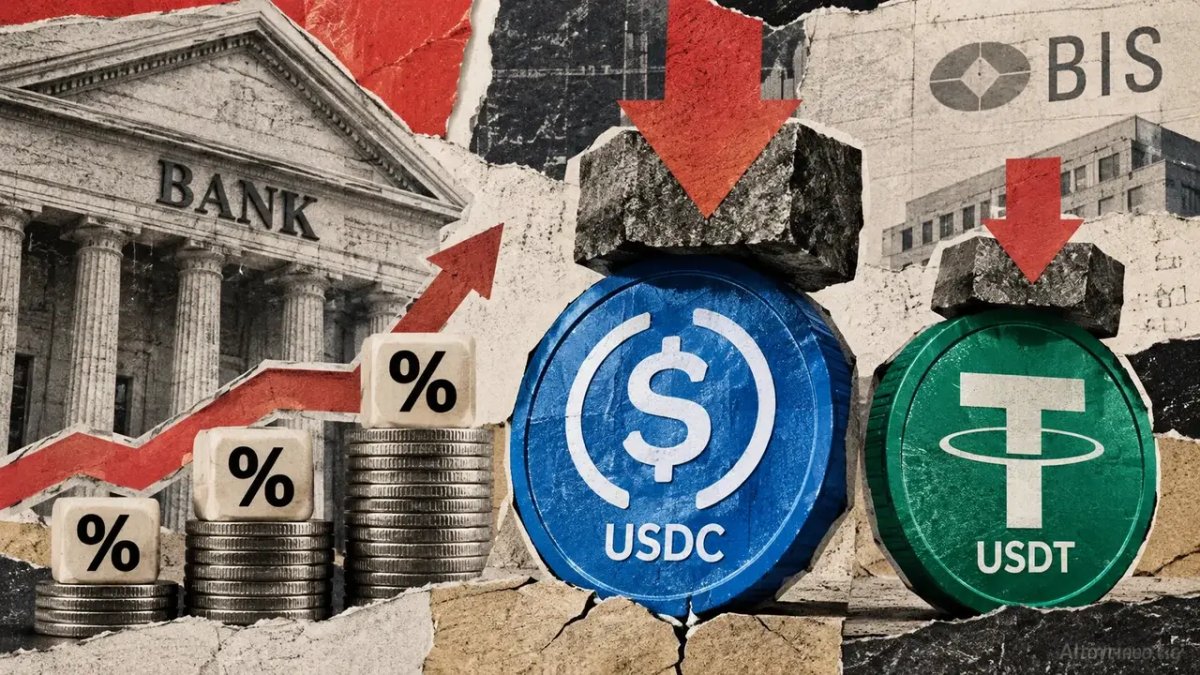
A study released by the Bank for International Settlements on Oct. 13 links bank deposit repricing to a larger estimated slowdown in USDC growth than in USDT growth, so banks' offers can shape stablecoin adoption differently for each issuer.
Higher deposit rates give holders a stronger financial reason to keep balances at a bank. In the study, a one-basis-point deposit-rate increase was associated with about 4.8% less cumulative USDC growth over ten weeks, compared with 1.9% less growth for USDT.
Researchers Rashad Ahmed and Iñaki Aldasoro used weekly data from January 2019 through June 2025. The BIS published the October edition after a first version appeared on March 24, and the earlier abstract already reported the stronger USDC response.
Exchanges can offer variable rewards to eligible customers, adding another price to the competition for balances. That makes the historical issuer split useful for adoption forecasts while leaving today's bank-versus-platform comparison to be established.
The paper's deposit-rate measure averages six national savings and money-market deposit-account series. It is distinct from the Federal Reserve's policy rate and from the rate on any particular high-paying account.
The ten-week OLS point estimates separate the two issuers:
| Stablecoin | Estimated change in cumulative log market-cap growth per 1 basis point of deposit repricing |
|---|---|
| USDC | −4.8 percentage points |
| USDT | −1.9 percentage points |
Ordinary least squares (OLS) is the baseline statistical model, while the negative estimates describe slower growth relative to the model's comparison path.
The authors interpret USDC's larger response as consistent with its closer connections to US institutional and decentralized finance users. Those holders may have more reason to compare bank deposits with stablecoin balances, and they associate USDT's weaker response with its offshore and developing-economy uses.
The data cannot identify which individual holders switched or which bank accounts were involved, so the issuer explanation is an interpretation of the pattern.
For adoption forecasts, the implication is that a deposit-rate assumption applied to all stablecoins can conceal different competitive pressures. The point estimates suggest a stronger US deposit-pricing relationship for USDC in this sample, without establishing a fixed response for either token in every market environment.
For stablecoins in aggregate, the baseline ten-week estimate is about 2.8% less cumulative growth per basis point of deposit repricing. A second model, using an instrumental-variable approach intended to isolate deposit repricing, produces a larger estimate of about 9.1% less growth.
That approach exploits banks' stronger pass-through of policy-rate changes when the federal-funds target midpoint four weeks earlier was at least 3.125%. It depends on the resulting variation affecting stablecoin demand through deposit repricing after the other controls.
The controls cover policy and Treasury rates, Bitcoin prices, the dollar index, and market volatility, helping distinguish deposit-price competition from broader investment conditions, without proving the identification assumption.
The authors flag instrument weakness: the first-stage F-statistic is 9.78, below the conventional threshold of 10 they cite. With only one high-rate episode in the sample, the larger estimate has limited evidence to support its application to a different rate cycle.
In the paper's instrumental-variable charts, USDC's ten-week 95% confidence band remains below zero, while USDT's includes zero.
A separate deposit-tier comparison also supports the direction of the relationship, using differences in how banks reprice preferred money-market and savings accounts.
Checks for the Silicon Valley Bank episode, crypto events, trading volume, and DeFi yields retain negative relationships. Responses among balances supplied to lending protocols remain imprecise. The evidence supports competition, but its magnitude depends on the model and sample.
The return on a stablecoin balance is also shaped by the platform on which it sits. In research published June 19, the BIS distinguished two economic models for exchange payments to stablecoin holders.
Under reserve-based remuneration, an exchange transmits part of the income generated by the issuer's reserve assets to holders. Under activity-based remuneration, payments are tied to lending, trading, and other market activity.