
‘Holy Grail of Space Travel’: SpaceX Catches Starship
For the first time, SpaceX has caught a Starship rocket after a space flight. A historic breakthrough that could make space travel more affordable.
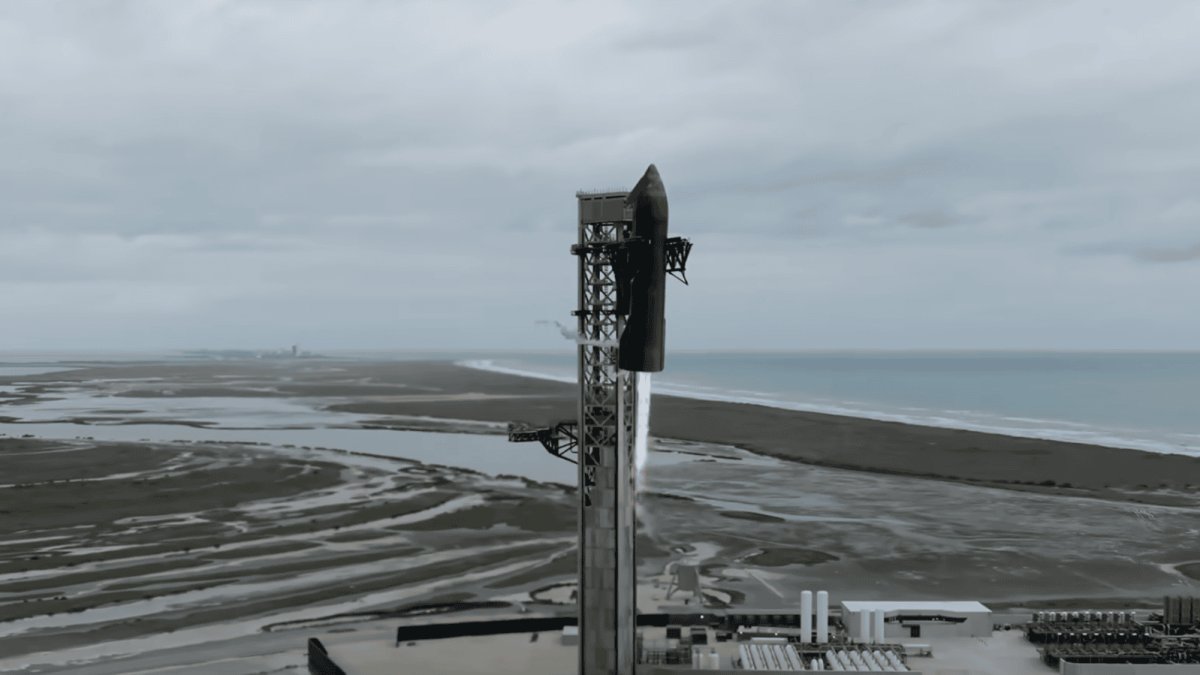
SpaceX has reached a historic milestone. For the first time, Elon Musk's space company has succeeded in catching the upper part of its enormous Starship rocket after a flight through space.
The spacecraft orbited the Earth fourteen times and, after more than 22 hours, was snatched from the sky by two gigantic mechanical arms at a launch pad in Texas. This achievement could have major implications for the future of space travel.
On Friday, SpaceX launched its Starship rocket from the Starbase launch site in Texas. It was the fifteenth test flight of the rocket, which is ultimately intended to be fully reusable. This time, the company wanted to safely return and catch both parts after the flight.
The upper part of the rocket, also called Starship, remained in space for over 22 hours and orbited the Earth fourteen times. Then began the return journey through the atmosphere. During this process, the spacecraft was exposed to extremely high temperatures as it hurtled toward Earth at tremendous speed.
The most spectacular moment followed on Saturday. The approximately fifty-meter-high spacecraft approached the launch tower, turned to a vertical position and decelerated using its engines. It was then caught by two gigantic steel arms on the tower. Because of their shape, these have been nicknamed "chopsticks."
That may sound simple, but it is technically very complex. Starship returns through the atmosphere at a speed of thousands of kilometers per hour and must then land in exactly the right spot. In the final seconds, the spacecraft must come to an almost complete standstill, while the engines and computers are constantly making minor corrections. Even a slight deviation can cause the rocket to miss the arms or collide with the launch tower.
In addition, the spacecraft does not use a traditional landing gear. Instead, it must be caught directly by the tower. This places exceptionally high demands on the system's accuracy.
This is the first time that SpaceX has caught the upper part of Starship in this way after a flight around the Earth. Previously, the lower part of the rocket had already been successfully returned several times using the same technique.
The successful maneuver is an important step toward fully reusable rockets. Normally, large rocket components are lost or end up in the sea after a flight. This means that new components have to be built for subsequent launches, which costs a lot of money and time.
If SpaceX can eventually reuse both parts of Starship over and over again, it could significantly reduce the cost of spaceflight. Rockets could also be launched much more frequently. This would make it possible to transport larger quantities of cargo and, eventually, people into space at lower costs.
However, not everything went according to plan. SpaceX also wanted to safely return the lower part of the rocket, known as the Super Heavy booster, to the launch pad.
However, shortly after the launch, problems arose during the return flight. A maneuver to restart the rocket engines was aborted prematurely. A warning about an insufficient amount of fuel may have played a role in this.
The automatic safety system then decided to abort the planned landing at the launch tower. The booster was redirected to a pre-designated area over the Gulf of Mexico, where the behemoth exploded just above the water's surface.
According to SpaceX, the safety system worked as intended. The company is still investigating why the booster did not land in the correct position to be safely caught.
With the successful return of Starship, SpaceX is one important step closer to its ultimate goal: to develop a rocket that can be reused after each flight.
With a total height of approximately 124 meters, Starship is the largest rocket in the world. The system consists of the powerful Super Heavy booster and the upper stage, which is designed to transport people and cargo into space.
According to Elon Musk, full reusability is essential to make space travel much cheaper. If rockets do not have to be rebuilt after every flight, the cost of launches can be significantly reduced.
SpaceX ultimately intends to use Starship for manned missions to the Moon and Mars. The US space agency NASA is also counting on the spacecraft for future moon landings.
Although the test flight did not go entirely according to plan, it was the first time that a Starship was successfully returned to the launch site intact after a flight around the Earth. SpaceX has thus taken an important technical step toward rockets that can be fully reused.