
Britain to spend £4 billion on grid bottlenecks. Can Bitcoin use the wasted wind?
Flexible mines could use curtailed Scottish wind, but most recent constraint spending paid for replacement power elsewhere. Read the full story on CryptoSlateUnderstand the crypto stories that matter and what to watch next. Get The Catalyst in your inbox
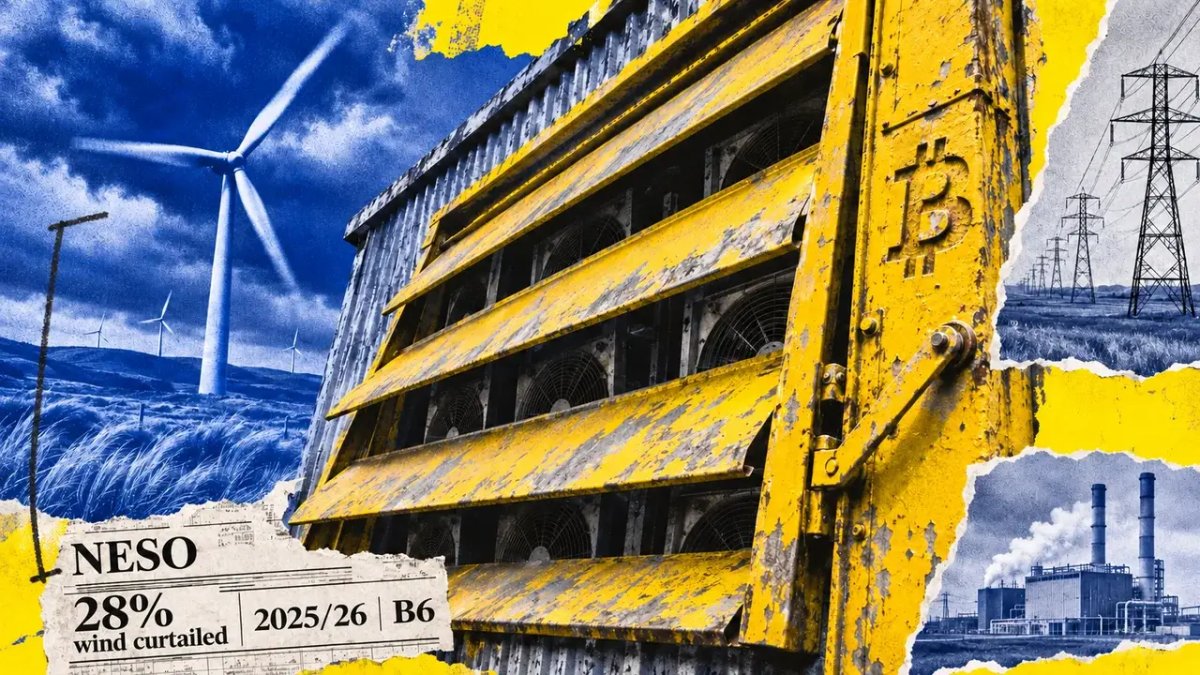
Britain’s grid operator forecasts about £4 billion in costs from transmission bottlenecks in 2027, putting a practical question to Bitcoin mining’s flexible-power pitch: can miners cut costs by using Scottish wind that cannot reach other consumers?
The National Energy System Operator (NESO) published the forecast on Nov. 12. Its latest cost breakdown shows why the answer depends on where a mine connects and which expense it actually avoids.
Thermal constraints arise when transmission lines cannot safely carry all the available electricity. NESO can then pay generators to reduce output while securing replacement supply elsewhere.
The forecast concerns thermal constraints, rather than all electricity balancing costs. It is sensitive to gas prices and network availability. NESO estimates costs would be 16% lower without network outages, although those outages also enable reinforcement intended to ease future bottlenecks.
In its Nov. 9 outturn explanation, NESO reported total balancing costs of about £3 billion for 2025/26, including roughly £2 billion for thermal constraints. A little under £500 million was paid to wind farms to turn down.
Around 75% of thermal constraint costs paid for replacement energy, predominantly from gas units.
Scotland nevertheless presents a potential use case. NESO says 28% of wind in the northern area above a transmission boundary known as B6 was curtailed in 2025/26, compared with 13% across Great Britain.
Related ReadingA flexible mine could reduce wind turn-down costs by consuming otherwise curtailed electricity at a connection and time that helps manage the relevant bottleneck. But adding northern demand does not itself deliver more power south. While the boundary remains binding and southern demand is unchanged, replacement supply remains necessary there.
That limits the savings claim: reduced wind turn-down does not establish an equivalent reduction in gas generation, consumer bills or emissions.