
Uniswap adds seven trading sources as 0x disputes its protection from malicious hooks
Uniswap Labs launched aggregator hooks on Ethereum, Base, and Robinhood Chain on Oct. 22, letting its web app and API route swaps through external liquidity from Curve, Fluid, PancakeSwap, and other venues. The new adapters were developed by Uniswap Labs. In a separate September study of third-party hooks, trading aggregator 0x reported that malicious Uniswap… Read the full story on CryptoSlateUnderstand the crypto stories that matter and what to watch next. Get The Catalyst in your inbox
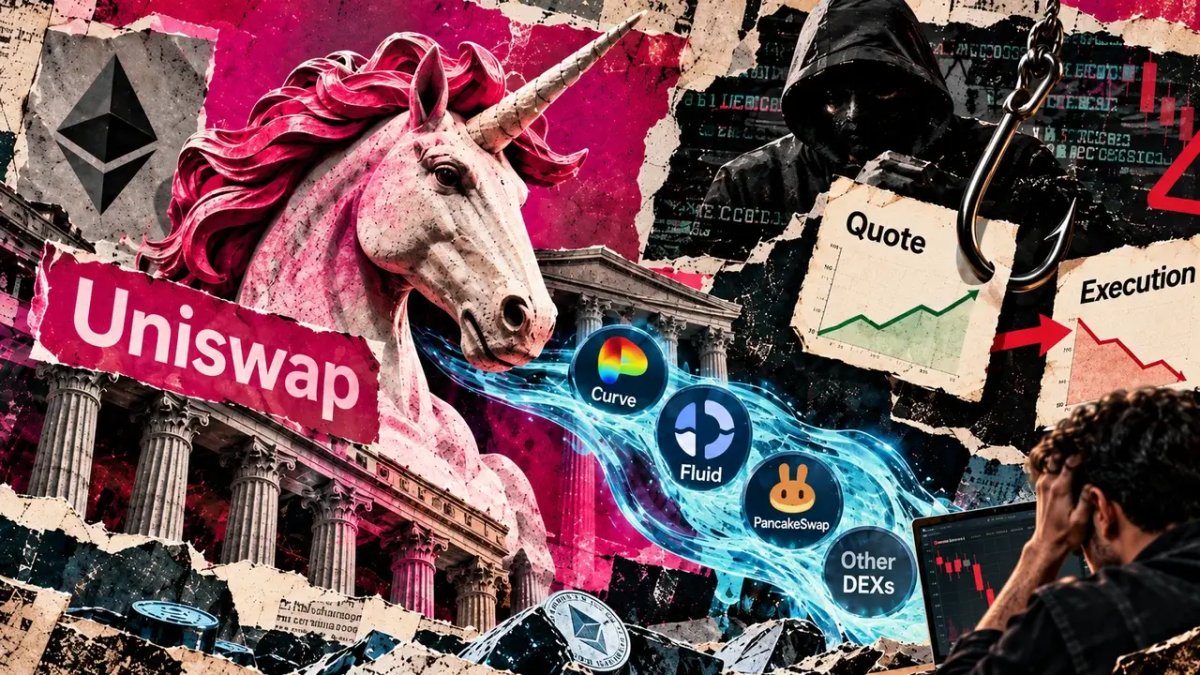
Uniswap Labs launched aggregator hooks on Ethereum, Base, and Robinhood Chain on Oct. 22, letting its web app and API route swaps through external liquidity from Curve, Fluid, PancakeSwap, and other venues.
The new adapters were developed by Uniswap Labs. In a separate September study of third-party hooks, trading aggregator 0x reported that malicious Uniswap v4 hooks quoted one price and settled at another, with some trades delivering as much as 50% less than quoted.
Uniswap's founder Hayden Adams rejected the criticism then, and the public record shows documented mitigations alongside unresolved disputes over whether they work.
0x's Sept. 14 research examined 84,163 hooks across six chains and, as of Sept. 11, classified 19.4% as safe, 54.2% as malicious and 26.4% as “likely malicious.”
A malicious pool shows a favorable price during a quote request, wins the route, and behaves differently at execution. One Base hook recorded 6,516 fills and $143,037 in fees, and a BNB Chain hook recorded 4,879 fills and $18,592.
The 50% shortfall is the largest reported outcome, and the figures are 0x's own classifications. 0x competes with Uniswap's router as an aggregator, and it says roughly 70% of its transactions touch Uniswap liquidity.
Adams replied on Sept. 15 saying that it was a “skill issue,” arguing that users shouldn’t route trades to bad hooks. He offered help to teams having trouble screening hooks and defended v4 hooks as a source of innovation.
He also promoted Uniswap's own API as a way to reach broad liquidity at competitive prices while avoiding malicious hooks.
Paradigm's Dan Robinson made the same argument in sharper terms, saying 0x's post should have been titled “0x routing made a mistake.”
He pointed to Uniswap's hook-approval process and said routers should vet arbitrary hooks before treating them as liquidity. Paradigm is closely associated with Uniswap, and Robinson spoke in his own name, separate from Uniswap Labs.
The shared position from Uniswap and Paradigm is that aggregators should vet which hooks they route to and that Uniswap's own router already does.
0x has also questioned that protection. Engineer Duncan Townsend said 0x already used Uniswap's allowlist and alleged that at least one malicious hook sat on it. The 0x study also describes hooks that detect quoting environments and return different execution prices.
0x director of engineering Philip Liao cited a Robinhood Chain transaction, allegedly routed through Uniswap's interface, in which a malicious hook took 4.8% of one routing leg, or 1.2% of the overall trade.