
The hidden trade behind Strive’s 16.7% Bitcoin income offer
There's a Bitcoin company that's now offering investors a 15% annual dividend, paid in small installments every business day. While a 15% dividend is high enough to grab everyone's attention, the more revealing number is what buyers agreed to pay for it. On Oct. 15, Strive priced seven million shares of its new SATS preferred… Read the full story on CryptoSlateUnderstand the crypto stories that matter and what to watch next. Get The Catalyst in your inbox
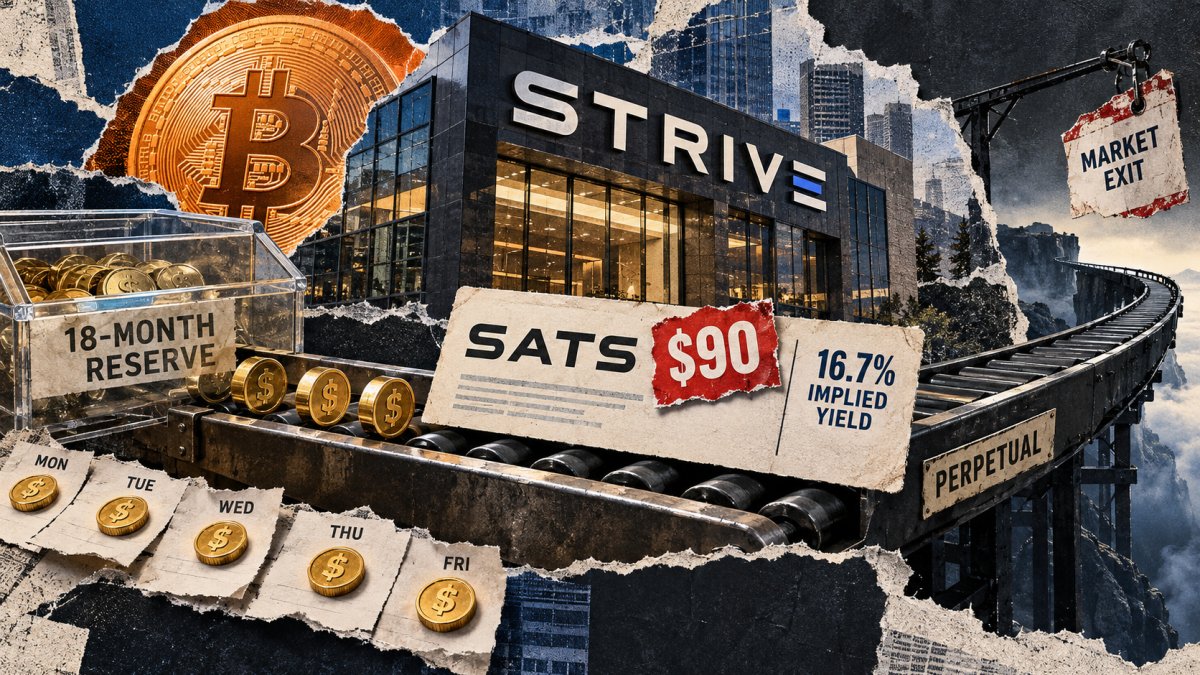
There's a Bitcoin company that's now offering investors a 15% annual dividend, paid in small installments every business day.
While a 15% dividend is high enough to grab everyone's attention, the more revealing number is what buyers agreed to pay for it.
On Oct. 15, Strive priced seven million shares of its new SATS preferred stock at $90 apiece, despite each share carrying a $100 stated amount and a $15 annual dividend. That puts the implied cash yield at 16.7% for someone buying at the offering price.
The upsized offering is expected to raise $630 million before expenses, with settlement scheduled for Oct. 20. Strive will use the proceeds to acquire Bitcoin, support its business, buy income-generating assets, or repurchase other shares.
The eye-popping yield makes the product easy to advertise and sell. However, it doesn't tell us what an investor bought for $90, or what that investment would be worth if they needed their money back.
SATS is preferred stock, which means its owners are in a different position from shareholders who buy Strive's ordinary stock.
Common shareholders receive whatever value remains after the company satisfies its liabilities and more senior claims. Preferred holders receive contractual payment rights and a higher place in the repayment order, but their upside is generally more limited.
Strive's prospectus sets an initial liquidation preference of $100 per SATS share, subject to adjustments that can't reduce it below $100.
That preference determines the claim investors can assert under the relevant liquidation provisions, and it doesn't mean a holder can demand $100 whenever they want to sell.
The market price depends on what another buyer is willing to pay for the dividend stream and its associated risk. That's the most important difference by far, particularly because SATS is perpetual. There's no maturity date when the company must return the investor's original purchase price.
So, a share bought at $90 could trade at $100 or more if buyers get comfortable with the company's finances and accept a lower yield. It could also fall to $75, even if Strive continues making every scheduled payment.
The calculation is straightforward:
| Purchase price | Annual dividend if paid in full | Current cash yield |
|---|---|---|
| $75 | $15 | 20.00% |
| $90 — announced offering price | $15 | 16.67% |
| $100 | $15 | 15.00% |
| $110 | $15 | 13.64% |
Illustrative yields calculated from the $15 annual dividend. Market prices other than the $90 offering price are hypothetical. Cash yield excludes price changes, fees, and taxes.
Someone who pays $90, collects $15 over a year, and sells for $75 receives $90 in total before costs. If every dividend were paid on time, the investor would still have made nothing.
If the resale price falls further, the payments might not even cover the capital loss. If it increases, the buyer can earn more than the advertised income. That's why the advertised 15% is just a contractual dividend rate.
The word preferred might sound like a promise of safety, but its value depends on who stands above and below the investor in practice.
SATS ranks ahead of Strive's common shares for dividends and liquidation distributions, but behind all of its existing SATA preferred stock. Debt and certain obligations at subsidiaries also take priority, while the company retains the ability to issue additional securities with equal or higher ranking.
Consider a simplified company with $200 available after other liabilities, $100 owed to senior preferred shareholders, and $50 owed to junior preferred holders. The remaining $50 belongs to common shareholders, so a $40 decline in available assets would hit common shareholders first.
Another $30 decline would wipe out the remaining common value and leave the junior preferred holders $20 short, but the senior preferred claim would still be covered.
That's the protection junior preferred owners are buying: common equity can absorb some losses before they do. But that protection thins as senior claims grow or the company's asset value falls. For Bitcoin treasury companies, both can happen at once.