
The future of onchain FX could start with users, not institutional liquidity
Onchain FX does not need to recreate the trillion-dollar institutional market to become useful. Real demand can make smaller markets work first.

Opinion by Michael Egorov, founder of Curve Finance and Yield Basis
For a long time, the obvious way to think about onchain foreign exchange (FX) was to start at the top. Banks tokenize currencies, large financial institutions move their FX activity onchain and institutional liquidity naturally follows.
The end result? Blockchain-based FX eventually grows large enough to resemble its traditional counterpart. But that’s not necessarily how it is going to happen.
In fact, there are growing signs that onchain FX will develop in the exact opposite way — from the bottom up.
Stablecoins like Brazilian Digital (BRZ) or Monerium’s EURe can be quickly redeemed onchain and easily moved from digital wallets to bank accounts. They generate healthy trading activity as decentralized finance (DeFi) users swap them in decentralized exchange (DEX) pools.
Markets like this end up developing in real time around a practical user need, which is moving directly between digital currencies and fiat.
This is still just an early-stage example, but the use case and demand are real enough. Keyrock data shows that the majority of onchain stablecoin trades tied to emerging market currencies fall in the $1,000 to $10,000 range — modest amounts compared to institutional scale — but that’s precisely the point.
It shows how the market is building in the general direction of onchain FX to meet practical payment needs, not just large traders.
People and businesses need to move their money between currencies, and clearly, they are not content to wait for major traditional finance (TradFi) institutions to move their FX operations onto blockchain rails.
Related: Paraguay bank collapse shows stablecoins can offer a lifeline... of sorts
There’s a pretty common assumption about onchain FX in that a market needs huge liquidity before it can become really useful. In practice, though, that’s not entirely true.
If there is genuine demand from someone who needs to exchange dollars into euros, Swiss francs or another currency, even a smaller pool can process those transactions and serve a real economic purpose.
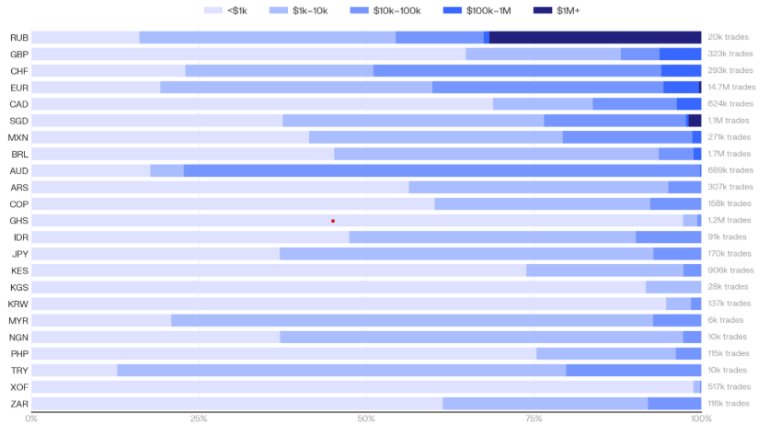
Stablecoin DEX Trade Volume. Source: Keyrock Research
Onchain FX doesn’t need to become big before it becomes useful; instead, it can grow precisely because people are actually using it.
As a matter of fact, this is more or less what happened with stablecoins. They began as a relatively niche crypto-native use case, and yet today we already know them to be part of a much broader financial infrastructure.
Chainalysis recently shared data that shows cross-border stablecoin activity jumped to over $220 billion by mid-2026. That’s an almost 80% growth over the course of one year, proving that demand and activity are constantly on the rise. There is no reason onchain FX can’t follow a similar path.
This is actually the most practical side of this issue. Onchain FX obviously won’t be able to compete with the entire global foreign exchange market anytime soon; that’s still years away. But the more interesting question is what problems it can solve for someone who already has money onchain.
Today, you can exchange a USD stablecoin into a EUR stablecoin (or some other alternative) onchain and use that money for payments with relatively little trouble. In fact, doing it this way is often faster and cheaper than going with a classic international bank transfer.