
Ten tokens held 62% of altcoin futures exposure, but shared collateral can put other positions at risk
Talos’s September 24–30 snapshot showed concentrated positions; PUMP funding on Binance changed paying sides between October 5 settlements. The post Ten tokens held 62% of altcoin futures exposure, but shared collateral can put other positions at risk appeared first on CryptoSlate.
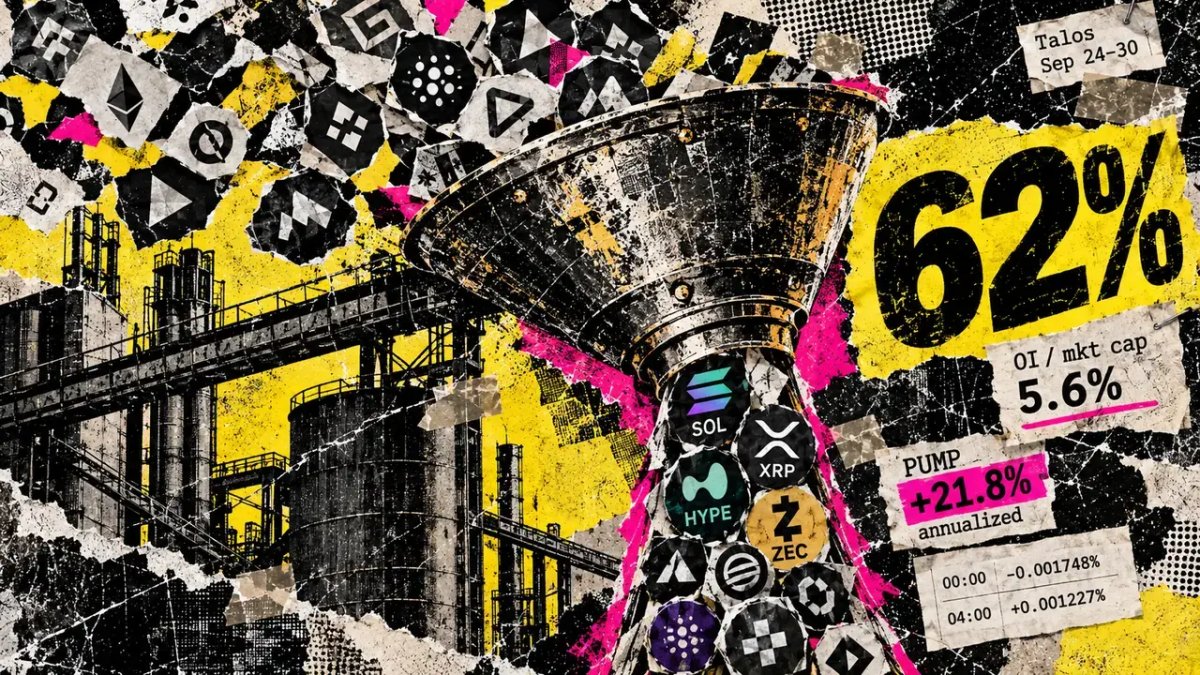
Ten tokens accounted for 62% of outstanding altcoin futures exposure, known as open interest, in Talos’s weekly market report covering September 24–30, 2026. That concentrated exposure came with different financing burdens: the report put SOL funding below zero while PUMP funding reached +21.8% annualized.
Published October 1, the market report also put altcoin open interest relative to market capitalization at 5.6%, a record in Talos’s series. For investors entering the October trading week, those numbers identify a concentrated derivatives footprint, while later Binance settlements show how quickly the cost of holding a particular contract can change.
Perpetual futures use funding payments to help keep the contract price aligned with the underlying market. As Hyperliquid’s funding mechanics explain, positive rates transfer money from long holders to short holders. Negative rates reverse that direction. A trader’s financing burden therefore depends on the contract, side and funding interval, even when two tokens both have substantial open interest.
The October 5 refresh covers two Binance contracts, rather than a matching update to Talos’s altcoin aggregate. Their settled payment records, retrieved shortly after 04:20 UTC, show positive SOL funding and a PUMP rate that changed sign within four hours.
| Binance contract | Settlement, Oct. 5, 2026 (UTC) | Native settled funding rate | Paying side |
|---|---|---|---|
| SOLUSDT | 00:00 | +0.010000% | Longs pay shorts |
| PUMPUSDT | 00:00 | -0.001748% | Shorts pay longs |
| PUMPUSDT | 04:00 | +0.001227% | Longs pay shorts |
Sources: Binance’s SOL settlements and PUMP settlements. Rates are native settlement percentages, not annualized rates.
SOL’s preceding observed payment, at 16:00 UTC on October 4, was also +0.010000%, eight hours before the midnight payment. PUMP’s two observed payments were four hours apart.
PUMP’s midnight payment charged shorts; its 04:00 payment charged longs. The change illustrates a financing burden that can reverse while the underlying contract remains the same. SOL’s positive midnight payment also differs from the negative funding described in the earlier Talos snapshot.
Annualization puts periodic rates on a common comparison basis, rather than locking in a year’s costs. Coin Metrics’ per-market documentation distinguishes the period a rate applies to from the input window used to calculate it. Hyperliquid settles hourly while dividing an eight-hour formula into hourly payments.
Coin Metrics’ aggregate methodology weights normalized market rates by dollar open interest and scales longer aggregate periods linearly. Its daily series is a boundary sample rather than a daily average. Those definitions describe available metrics; they do not identify the precise series or averaging window behind Talos’s +21.8% PUMP figure.
Related ReadingTalos named SOL, XRP, HYPE and ZEC among the largest markets in its top-ten group. The 62% share identifies where exposure sat within its tracked altcoin bucket. Establishing whether those tokens carried unusually large derivatives positions for their size would require comparing their exposure share with their share of market value, using the same assets and timestamp.