
Paraguay bank collapse shows stablecoins can offer a lifeline... of sorts
Ueno’s collapse exposed the fragility of digital banking in Paraguay, as customers scrambled for access to their money and stablecoins offered a lifeline.
The collapse of Paraguay’s digital lender Ueno Bank last week left nearly three million customers — roughly 60% of Paraguay’s adults — unable to access their accounts.
Paraguay’s Central Bank placed Ueno into resolution on Nov. 3 after its solvency ratio fell below half the legally required minimum. An investigation uncovered questionable lending practices and deficiencies in credit documentation and accounting.
The collapse also triggered a political crisis, with thousands taking to the streets to protest and President Santiago Peña attempting to resign before being impeached and arrested on charges of breach of trust and using his office for personal gain.
Paraguay’s peer-to-peer crypto market immediately reflected the turmoil, with some sellers asking for a USDt premium of up to 13%. “USDt is a lifeline for hundreds millions of people in the world,” Tether chief executive Paolo Ardoino said.
For many, the incident sparked uncertainty over savings, wages and the money needed to cover everyday expenses. With the local guaraní (PYG) currency falling 12.3% in a week, some turned to stablecoins to maintain the value of their funds, or just to keep payments moving along.
David Eisenmann, founder and chief executive of Paraguayan crypto exchange X4T, tells Magazine the timing made the liquidity need even more pronounced.
“The intervention came in the first days of the month,” he says, “exactly when salaries, rent and supplier invoices are due,” adding that many business owners “couldn’t make payroll.” For some, USDt was “suddenly the most liquid money” they had:
“This week they learned that having an account isn’t the same as having access to your money.”
But beyond another TradFi masterclass in the virtues of self-custody, Ueno’s collapse highlights the growing role of dollar-pegged stablecoins providing an alternative source of liquidity when traditional banks fail.
Eisenmann says X4T processed more than $10 million in local on-ramp volume over the 30 days to early November, but some of that activity predated Ueno’s collapse.
“The dollar began recovering against the guaraní in October,” he says, “and the Ueno news sped up a move that was already underway.”
Related: Stablecoins can drain from banks and nations at lightning speed
He says the activity “runs in both directions,” with some customers selling crypto for guaraníes or dollars to cover payments they could no longer make through Ueno, while “demand for USDt and USDC as a dollar store of value has risen sharply.”
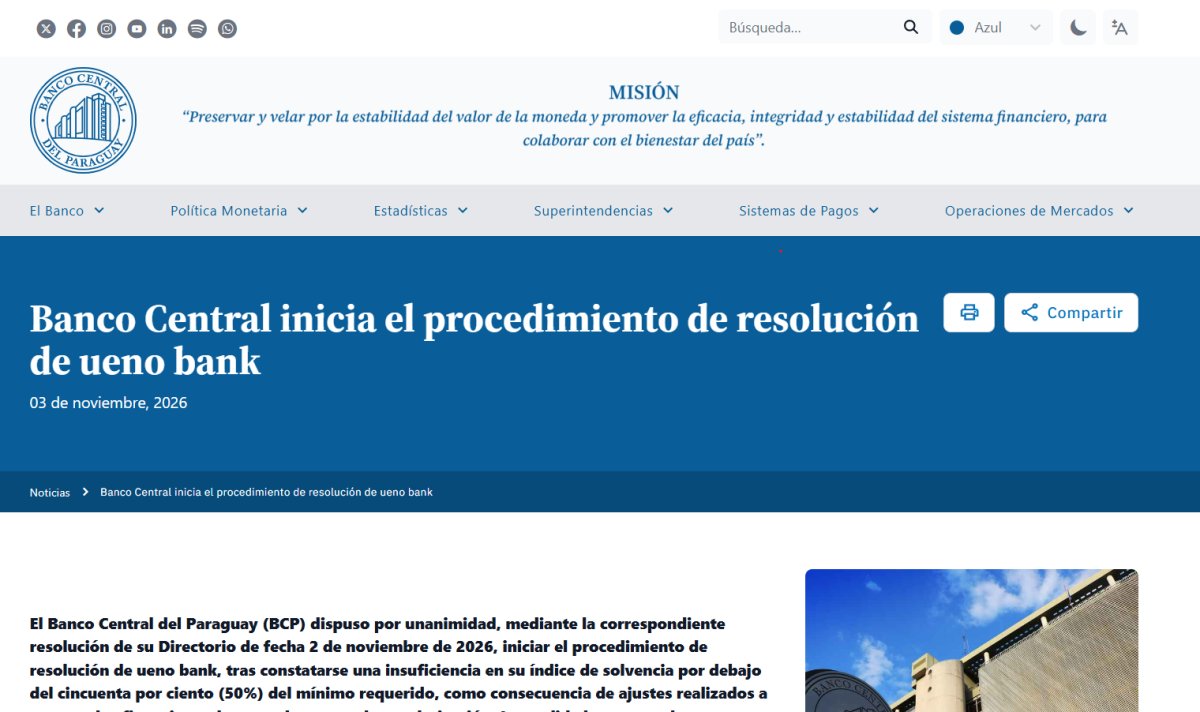
Paraguay’s Central Bank placed Ueno into resolution on Nov. 3. Source: Central Bank of Paraguay
As of Nov. 9 the Central Bank said 93.1% of customers with Ueno deposits had been repaid. Despite this confidence has been shaken and X4T continued to see higher online inquiries for dollar-denominated stablecoins. In fact, Eisenmann says the level “has not changed significantly” from the week of the collapse.
Rhys Hicks, associate analyst at data and analytics company GlobalData, says the digital bank’s failure has shown “how much can go wrong when governance does not keep pace with growth.”
That said, he’s not seeing evidence of a mass migration from Paraguayan banks into stablecoins, since other banks “picked up the slack,” and people “seem to have been angrier” with the government than with the banks.
“Some consumers will look for different ways to keep their money safe, but I do not see an overwhelming shift to stablecoins yet,” he says.
Seeking dollars when confidence in domestic banks falters is hardly new. In Argentina’s 2001 financial crisis, the government imposed the “corralito,” restricting cash withdrawals from bank accounts, following a run on deposits.