
Jeff Bezos: "Thanks to AI, a family will soon be able to live on one salary"
Jeff Bezos expects AI to enable families to make ends meet on a single income. Other tech leaders are warning of job losses and uncertainty.
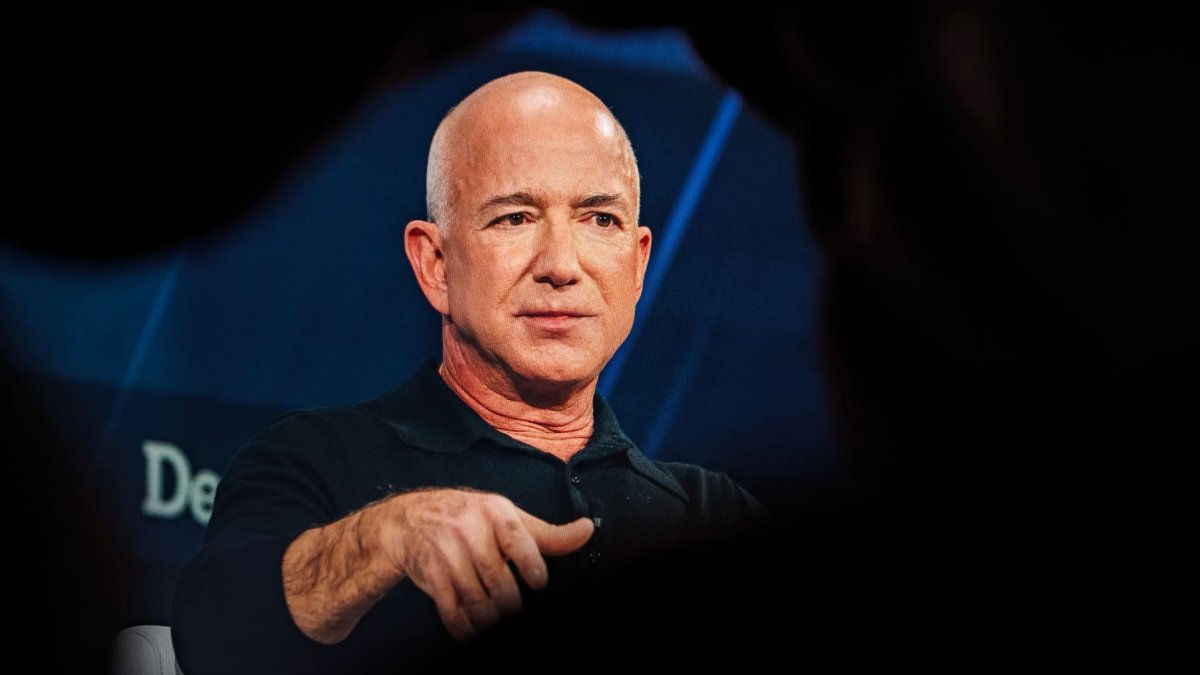
Artificial intelligence can radically change family life. Amazon founder Jeff Bezos expects technology to deliver such significant productivity gains that, in the future, families will be able to live on a single income.
According to him, a three-day workweek would also become possible. Other prominent technology leaders, on the other hand, are warning of significant job losses and a turbulent transition.
Bezos outlined his vision for the future in an interview with Fox News, recorded at a factory belonging to his space company, Blue Origin, in Florida. Thanks to AI, companies would be able to produce more with less human labor. As a result, he believes that both parents will no longer need to work to support a family.
Interestingly, Bezos does not foresee mass unemployment. On the contrary, he believes that employers will struggle to find staff because people will have the financial leeway to work fewer hours. At the VivaTech technology fair in Paris in June, he already stated that AI will ultimately create more jobs than it will eliminate.
This prediction runs counter to the trend of the past few decades. Figures from the Pew Research Center show that in 2025, 52 percent of heterosexual American couples with minor children had both parents working full-time. In 1975, that figure was still 31 percent. A return to a single-income household would therefore represent a major societal shift.
Bezos is also investing in this development himself. He is co-founder and co-CEO of Project Prometheus, an AI company that launched with $6.2 billion in funding. The company focuses on applications in fields such as engineering, aerospace and the automotive industry. Bezos expects AI to make technical work accessible to many more people.
Not everyone shares his optimism. In May 2025, Dario Amodei, CEO of AI developer Anthropic, warned that about half of entry-level office jobs could disappear within five years. He considered a U.S. unemployment rate of 10 to 20 percent possible due to the rise of AI.
Microsoft co-founder Bill Gates also sees possibilities for a much shorter workweek, even as short as two days. At the same time, he warned in August that the transition to a society with a high level of AI could be one of the most turbulent periods in human history. According to Gates, world leaders are insufficiently prepared for the risks.
Research by MIT Sloan shows that AI is already influencing the way work is done, who is hired, and which skills employers value. The consequences for the labor market are therefore not merely a matter for the future.
The main uncertainty is how the benefits of AI will be distributed. Higher productivity does not automatically lead to higher salaries or shorter working days. Companies can also use the savings to increase their profits or reduce their workforce.
Amazon, in particular, demonstrates how these interests can clash. The company has eliminated around 30,000 office positions since the end of 2025, while planning to invest more than $200 billion by 2026, largely in data centers. This does not mean that all those jobs have disappeared due to AI, but it does illustrate that large technology investments do not automatically bring greater job security for employees.
Whether families will actually have enough with one income in the future therefore does not depend solely on what AI makes technically possible. Equally important is the share of economic benefits that goes to employees.