
How to preserve wealth and access funds during a national emergency
As geopolitical and technological threats multiply, the big question is whether you can hold on to your wealth and access funds when the system fails.

Amid kinetic war, cyberattacks and the prospect of the power grid failing, governments around the world have been encouraging citizens to prepare for major disruption.
In the UK, citizens have been stocking up on tinned food and bottled water in response to the government’s Be Ready campaign.
With fighter jets streaking across the skies of the Middle East, talk of a dirty bomb attack on Washington and the world’s largest software company going offline for a day, the possibility of disaster striking close to home is starting to look more realistic.
But what do you do with your money in times like these? How can you protect your wealth, but still be able to access it when the system fails?
There are two key aspects: choosing assets that maintain value even as the world goes up in flames, and being able to access funds during an emergency.
On the first point Maximilian Kunkel, chief investment officer for ultra-high-net-worth clients at UBS Global Wealth Management, tells Magazine, “We would caution against thinking of any single asset as ‘safe’ in all circumstances.”
Instead, he says wealthy investors should focus on building a portfolio that is “resilient across different scenarios,” with enough liquidity and diversification across asset classes, currencies and geographies.
The corporation’s 2026 global family office report, representing families with an average net worth of $2.7 billion, found 64% cited major geopolitical conflict as a concern over the next 12 months. These investors are not flocking to crypto for wealth preservation however.
“24% of family offices reported exposure to crypto or digital assets, but among those invested, allocations were typically only around 1%.”
Hadley Stern, head of institutions at Silence Laboratories and founder of Fidelity Digital Assets, explains that financial institutions may now place Bitcoin in the same category as gold, but it does not yet enjoy the same reputation as a safe haven.
“Gold has thousands of years of history [...] Bitcoin has less than two decades. But the reasoning people use is the same: a scarce asset that isn’t anyone else’s liability,” he says.
Related: Will gold’s ‘infinite mint bug’ make Bitcoin more valuable?
He advises against using it as a reliable hedge in a crisis; “I’d be careful with the hedge story,” he says. “Bitcoin is still volatile, and in a sell-off it often trades like other risk assets.”
Cash, by contrast, is handy for emergencies “for liquidity and paying bills,” but not for “holding value over long stretches,” he says.
Michael D’Alessio, chief operating officer at digital asset trading platform Talos, tells Magazine, there are early signs that Bitcoin is beginning to behave more like gold. He said that through the volatility around the US midterm elections Bitcoin’s correlation with equities remained high. However, over the same period, its correlation with gold also rose sharply, to around 0.75 on a 30-day basis as of early August:
“That’s a meaningful shift, and it’s exactly the kind of signal institutional desks are now watching.”
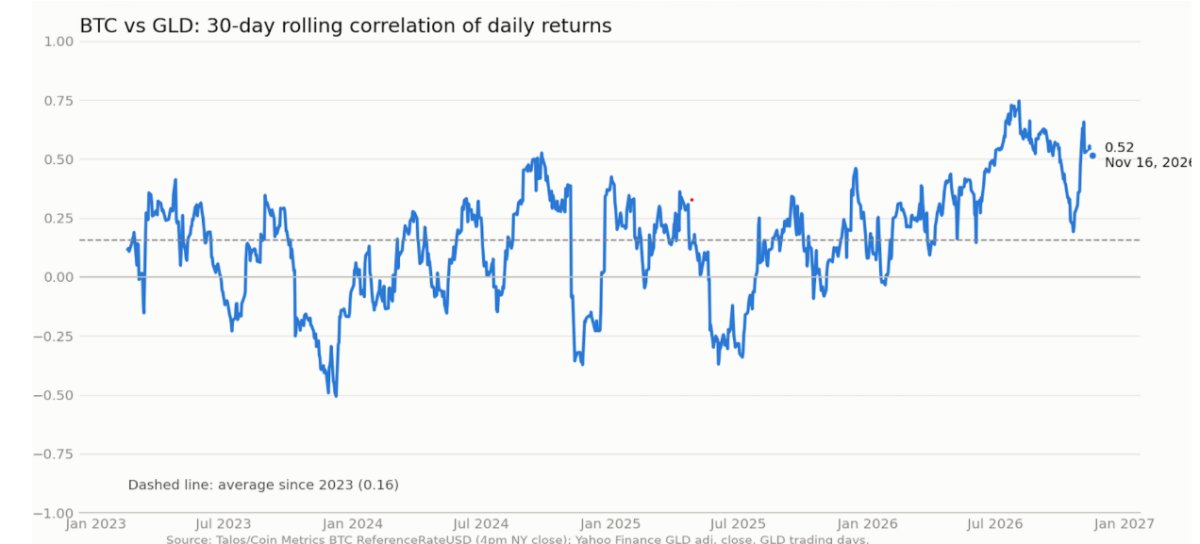
BTC vs gold, 30-day rolling correlation of daily returns. Source: Talos/Coin Metrics
The collapse of Mt Gox, or more recently the failure of Paraguay’s Ueno Bank show that “the asset is only as safe as the system holding it,” according to Stern.
Rather than automatically moving into Bitcoin or gold when tensions rise, risk committees are asking different questions:
“Where is the asset? Which jurisdiction is it in? Who can freeze it? What happens if a counterparty or a payment rail is down for a week?” he says. “Those used to be back-office questions. Now they come up at the board level.”
Kunkel said that concern over major geopolitical conflict is encouraging wealthy families to consider “not only asset allocation, but also where assets are held, currency exposure, liquidity and jurisdictional diversification.”
The UBS report found that 88% of family offices hold bankable assets in two or more jurisdictions, while 30% are increasing or considering increasing currency diversification.