
Hoskinson says Vitalik’s AI warning could delay the internet’s quantum defenses
Cardano founder Charles Hoskinson accused Vitalik Buterin of undermining quantum-resistant cryptography with speculative warnings about AI-driven mathematical breakthroughs. In an Oct. 9 post, Hoskinson challenged the Ethereum co-founder's skepticism toward lattice-based cryptography, arguing that decades of security research had already accounted for the technology's known weaknesses. He warned that encouraging developers to abandon established approaches […] The post Hoskinson says Vitalik’s AI warning could delay the internet’s quantum defenses appeared first on CryptoSlate.
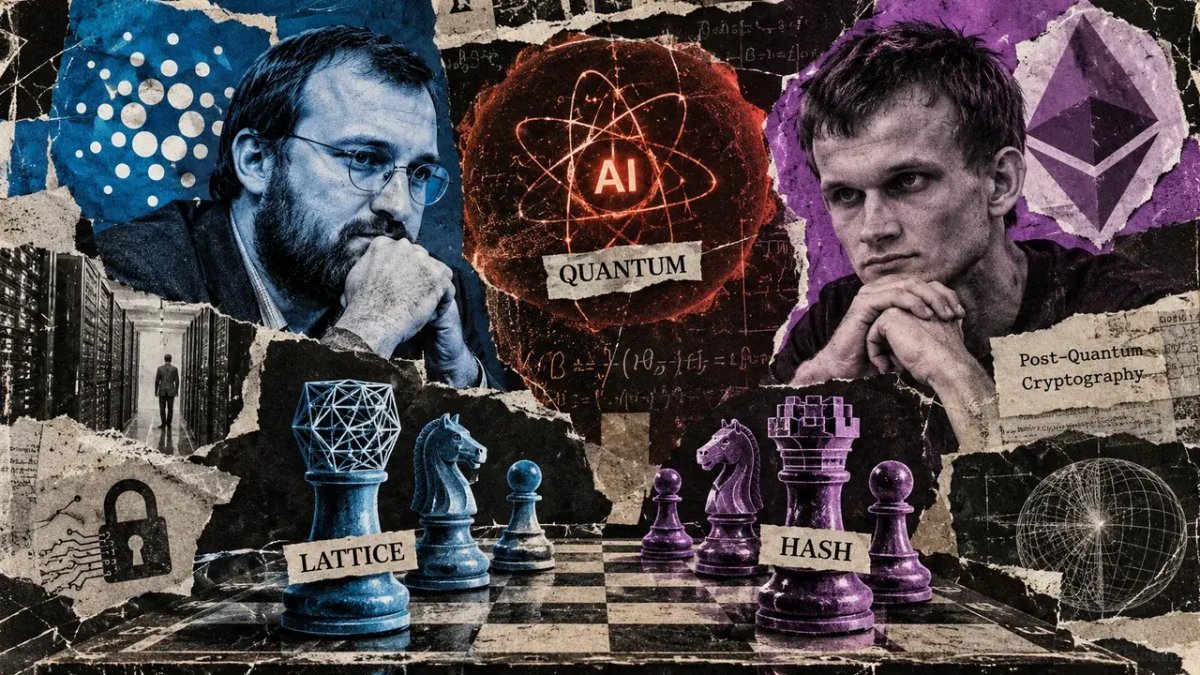
Cardano founder Charles Hoskinson accused Vitalik Buterin of undermining quantum-resistant cryptography with speculative warnings about AI-driven mathematical breakthroughs.
In an Oct. 9 post, Hoskinson challenged the Ethereum co-founder's skepticism toward lattice-based cryptography, arguing that decades of security research had already accounted for the technology's known weaknesses.
He warned that encouraging developers to abandon established approaches could slow the adoption of protections already being deployed across internet infrastructure, leaving systems exposed to future quantum attacks.
The criticism follows Buterin's warning that AI-assisted mathematical discoveries could weaken cryptography designed to resist quantum computers.
Buterin said Ethereum's long-term “lean” roadmap has moved toward hash-based signatures and proofs, avoiding lattice-based designs.
Hoskinson rejected that reasoning, accusing Buterin of being too invested in Ethereum's existing research direction to reconsider its approach.
“The case against lattices is the GNFS story, a.k.a. a hunch about ‘structure,' and a multiplier pulled out of thin air,” Hoskinson wrote.
The dispute concerns post-quantum alternatives to the elliptic-curve signatures used by Bitcoin and Ethereum.
Buterin's concern draws partly on the history of integer factorization, where mathematical advances such as the general number field sieve dramatically improved techniques for attacking RSA encryption.
He suggested that AI could deliver decades of comparable mathematical progress in a much shorter period, potentially revealing unexpected shortcuts against lattice-based systems.
Hoskinson said the number field sieve emerged from techniques involving arithmetic relationships and smooth numbers, while no comparable mechanism has been demonstrated against the lattice problems underpinning modern post-quantum standards.