
Hedge funds hold $2 trillion in US debt, but their next trade could require fewer bonds
Hedge funds held an estimated $2 trillion in cash US Treasuries at the end of 2025, or about 7% of the marketable debt outstanding, according to the Office of Financial Research. Much of that buying is tied to trades designed to earn small differences between bond and derivatives prices, which makes the funds great customers… Read the full story on CryptoSlateUnderstand the crypto stories that matter and what to watch next. Get The Catalyst in your inbox
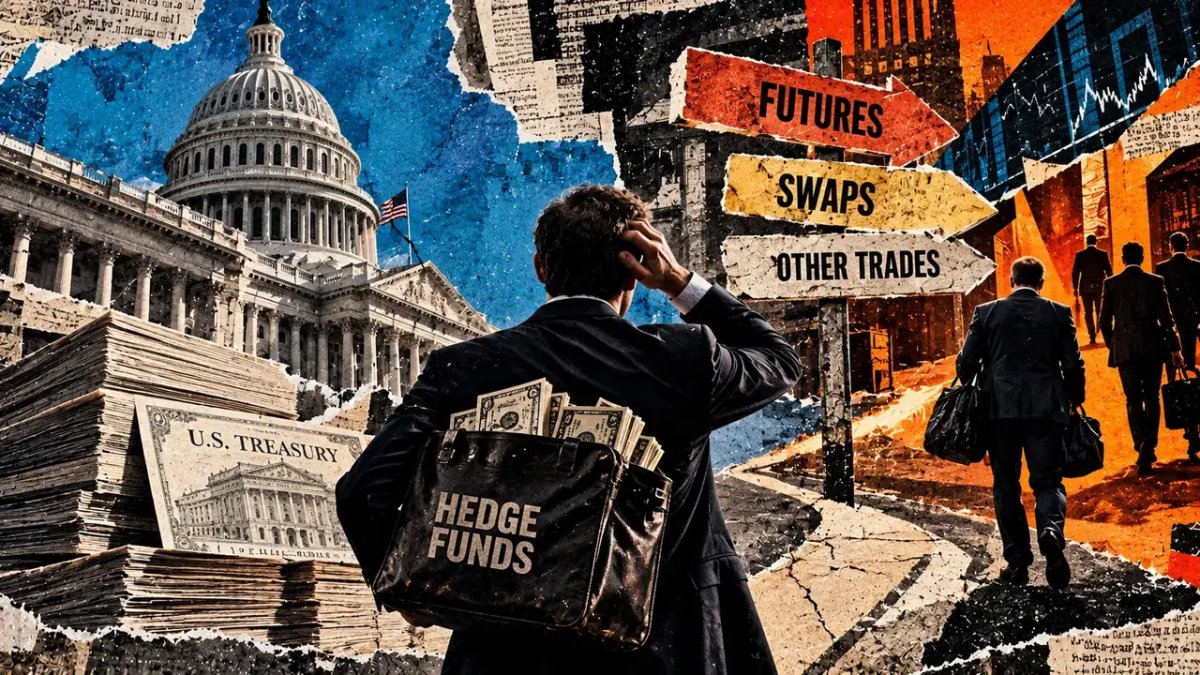
Hedge funds held an estimated $2 trillion in cash US Treasuries at the end of 2025, or about 7% of the marketable debt outstanding, according to the Office of Financial Research.
Much of that buying is tied to trades designed to earn small differences between bond and derivatives prices, which makes the funds great customers for Washington but hardly the kind of investors who buy government debt and forget about it for 30 years.
That's because hedge funds can own fewer bonds even while pursuing essentially the same business. Dallas Federal Reserve research published Oct. 16 found that alternatives to the cash-futures basis trade have become more attractive and, crucially, that reallocating a fixed amount of risk capital to those alternatives can produce a much smaller Treasury position.
That means that the government needs other investors to buy the securities that hedge funds no longer want to finance, potentially at higher yields.
The research lays out a different problem from the familiar story of leveraged investors dumping bonds in a crisis.
One involves managers deciding that borrowed money earns more elsewhere, while the other involves lenders or clearing arrangements demanding cash before a fund can obtain it. Both can affect Treasury prices and dollar funding, but only the second necessarily involves a scramble for liquidity that could spill into Bitcoin and other assets.
Hedge-fund balance sheets show expanding gross assets and broker financing in the second quarter of 2026, another reason not to treat a single Treasury strategy as a complete measure of funds’ borrowing.
Using the Federal Reserve's monthly Form PF-based series, the estimated cash-futures basis position rose from $213 billion in January 2023 to $832 billion in September 2025, while the swap-spread position went from $42 billion to $305 billion.
Those strategies accounted for roughly $1.14 trillion, or 47% of the $2.4 trillion in total long Treasury exposure reported for large hedge funds that September. Even though those positions are estimates, their relative sizes show what happens when markets become difficult to finance.
Asset managers who want exposure to government bonds can buy them outright or use Treasury futures, which allows them to obtain similar interest-rate exposure without actually holding the securities themselves.
When those futures become expensive relative to the bonds that can be delivered against them, hedge funds can buy the cheaper securities, sell futures, and try to collect the difference.
That cash-futures basis trade is designed to offset much of the exposure to interest-rate movements rather than express a view on whether US debt is worth owning.
Funds typically finance the cash bonds with repo, an arrangement that resembles a collateralized loan, and use their own capital to cover the portion a lender won't advance, futures margin, and the other costs of keeping both legs open.
Financing a hypothetical $100 million Treasury position with a 2% repo haircut would require $2 million toward the bond purchase, excluding futures margin and other expenses.
If that haircut rose to 4% without any movement in the bonds' value, the lender would advance $96 million instead of $98 million, leaving the fund to supply another $2 million, pledge other collateral, or sell some bonds.
| Measure | Amount | Date | What the estimate captures |
|---|---|---|---|
| Hedge funds' long cash Treasury holdings | $2 trillion | December 2025 | Estimated physical securities owned |
| Hedge funds' short Treasury futures positions | $1.4 trillion | December 2025 | Futures exposure, including hedges |
| Cash-futures basis positions | About $830 billion | September 2025 | Federal Reserve estimate of one trading strategy |
| Swap-spread arbitrage positions | About $305 billion | September 2025 | Federal Reserve estimate of another strategy |
Sources: OFR and the Federal Reserve's June 2026 decomposition. These numbers cover different measures and observation dates, so you can't add them together or treat them as four separate piles of bonds.
Selling Treasury futures is also not equivalent to betting that American bonds will fall. In a basis position, the short futures contract is paired with a long position in the securities, and the fund is trying to profit from the relationship between their prices.
That relationship can still turn against the trader, while losses on the futures leg can require immediate margin payments before gains on the bonds become usable cash.
The Dallas Fed identified a competing strategy that also starts with a Treasury purchase but pairs it with an interest-rate swap, in which the fund pays a fixed rate and receives a floating one.
This swap-spread widener can earn money when swap rates rise relative to Treasury yields, and its recent risk-adjusted return has become comparable to the classic basis trade.
Swap-spread trades can expose a fund to more dollar risk per $1 of notional position, which means a manager allocating the same amount of risk to the new strategy needs fewer bonds to support it.
Investors can keep running relative-value trades while borrowing less against Treasuries and supplying less cash demand to the government-bond market.
Take a hypothetical manager willing to tolerate a $10 million loss under a chosen stress scenario. If the basis position would lose 1% of its bond notional in that scenario, the risk allowance supports $1 billion in Treasuries.
If the replacement swap-spread position would lose 2%, the identical allowance supports only $500 million. Those percentages explain how a pretty ordinary portfolio decision can remove hundreds of millions in bond demand without a fund closing its doors.
The original basis trade has also become less appealing to some of the asset managers buying futures. A Treasury futures seller can choose among eligible bonds to deliver, and that option has value when the cheapest security to deliver can vary substantially.