
ETH fee burns cover just 2% of new coins printed in 2026
An October 9 ledger puts fee burn at 2.07% of gross issuance, while a conditional capacity model tests the demand needed to shrink supply. The post ETH fee burns cover just 2% of new coins printed in 2026 appeared first on CryptoSlate.
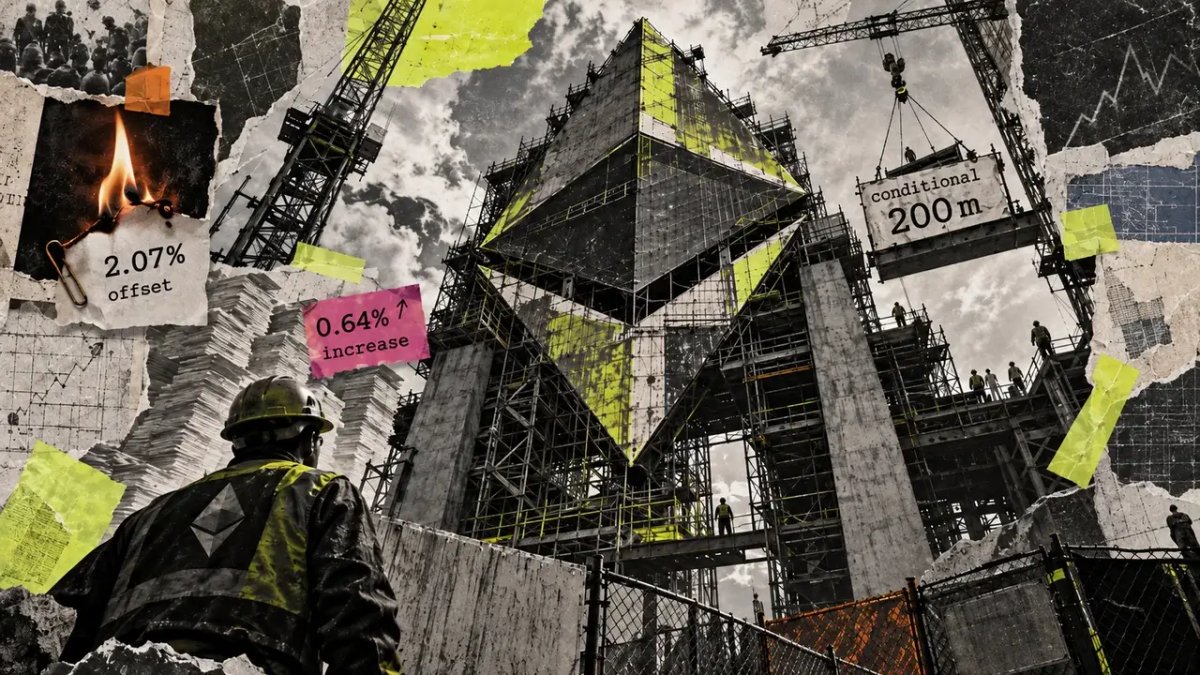
Ethereum's transaction fees have burned enough ETH to offset just 2.07% of the new coins issued in 2026, according to an Oct. 9 supply ledger.
After fee burn, validator penalties, and other destruction, the network has added approximately 778,413 ETH, increasing supply by about 0.64% from the window's opening level.
A larger gas limit can spread the necessary fee spending across more activity, lowering the required fee per gas and creating a hurdle for holders that expect scalability to make ETH scarcer. Developers pursue a conditional 200 million maximum gas goal after the Glamsterdam upgrade.
Using one current finalized accounting sample, an illustration puts the execution base fee needed to offset gross issuance at about 13.85 gwei with today's 60 million gas limit, or 4.16 gwei with a hypothetical 200 million limit.
Both require roughly 2,992 ETH of daily burn under the model's assumptions.
The ethsupply.fyi retained ledger covers Jan. 1 at 00:00:11 UTC through Oct. 9 at 15:44:23 UTC. It reports 796,623.377 ETH of gross issuance against 16,524.553 ETH destroyed through execution and blob transaction fees.
A further 1,685.919 ETH was removed through consensus penalties, with 0.059 ETH in other execution destruction. Subtracting these components leaves 778,412.846 ETH in net additions.
Those categories explain why the fee-burn offset is 2.074%, while the offset from all destruction is 2.286%. The latter includes penalties that do not represent customers paying for Ethereum activity. Treating the larger figure as transaction-fee demand would overstate how much issuance users have offset.
The provider's methodology separates newly created validator rewards from execution base fees, blob fees, penalties, and rare destruction through SELFDESTRUCT. Transfers, staking deposits and withdrawals preserve supply while moving existing ETH between accounts or accounting layers.
Its same-cutoff supply snapshot reports approximately 122.116 million ETH. Subtracting the net additions implies about 121.338 million ETH at the window's opening, producing the roughly 0.64% increase.
The 2.074% offset covers the cumulative 2026 window, while a current daily burn rate would require a separate daily comparison.
Ethereum's EIP-1559 fee mechanism burns the execution base fee on gas actually consumed. Priority fees go to block producers. Blob base fees also destroy ETH, while MEV payments and application revenue do not automatically become protocol burn.
The base fee, quoted in gwei, determines the ETH burned for each unit consumed. With an elasticity multiplier of two, a 60 million gas maximum corresponds to a 30 million target. A hypothetical 200 million maximum would imply a 100 million target if that rule remains unchanged.
A finalized mainnet beacon block at slot 15,394,656 contains execution block 26,155,767, timestamped Oct. 9 at 15:31:35 UTC, with a 60 million maximum. The matching execution-block record shows a base fee of approximately 0.335 gwei.
The supply consequence depends on consumed gas multiplied by its base fee, plus blob burn and other destruction. An unused increase in capacity cannot burn ETH, nor does a larger transaction count by itself establish greater burn if the transactions require less gas or pay lower base fees.