
Are you getting the AI you paid for? Anthropic’s new AI verification tool has a costly catch
FlashProve could help verify model computation, but its benchmark takes roughly 70 to 95 times the GPU work of ordinary inference. Read the full story on CryptoSlateUnderstand the crypto stories that matter and what to watch next. Get The Catalyst in your inbox
When you pay for access to a named AI model, identifying it from its answers alone remains unreliable. A convincing reply can show that a service works, while leaving a more basic purchase question unresolved: did the model you selected actually do the work?
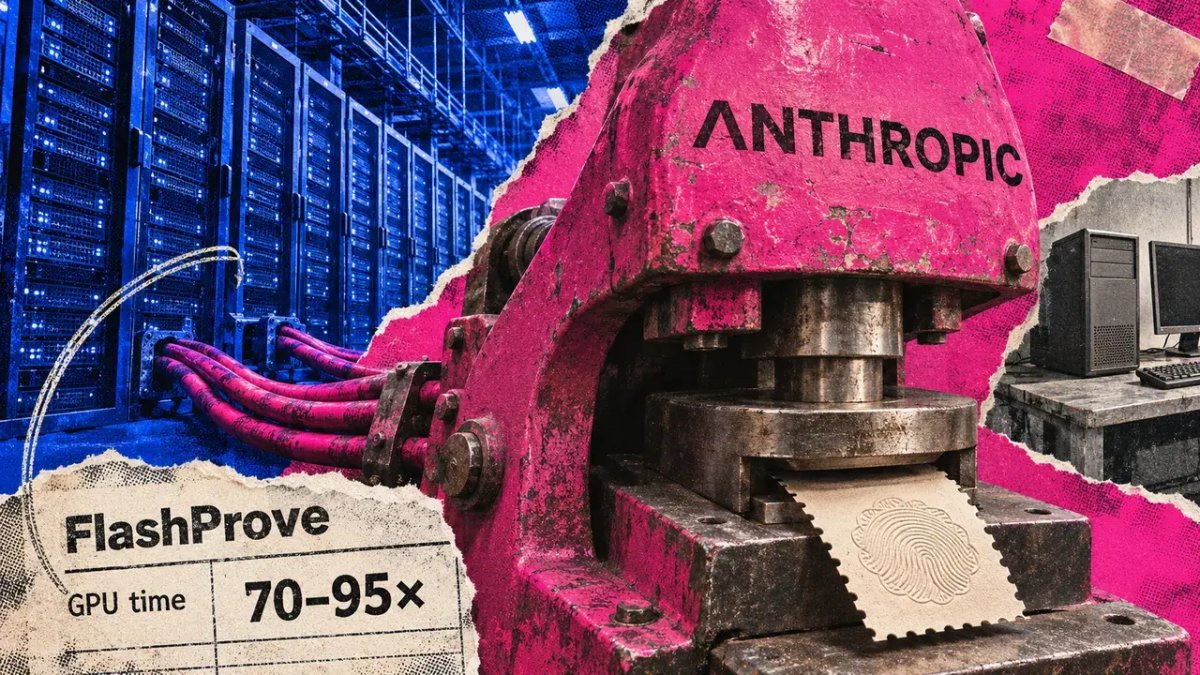
Anthropic's FlashProve research release, published Nov. 2, offers a way to check model computation without exposing the model's private weights. The catch is the work required to produce that assurance: roughly 70 to 95 times the GPU time of ordinary inference in the company's benchmark.
That makes FlashProve a potential safeguard for buyers using third-party AI services, with substantial distance still to travel before routine use. The demonstration uses Meta's Llama 4 Maverick, not a verification feature being switched on for Claude customers.
Related ReadingThe process begins before a response is checked. A provider publishes a cryptographic commitment to its model weights, the numerical parameters that determine how the model computes an answer. Think of it as a fingerprint that fixes which weights subsequent proofs must match, while keeping those weights hidden.
The provider then produces a proof that the committed model, given the specified input, produces the checked output. A verifier can check that proof without downloading the weights or running the model again.
For readers familiar with blockchain, this uses the same broad family of zero-knowledge proof techniques used to verify computation in Ethereum layer-2 systems. Here, the useful property is that someone can check the computation without learning the private information behind it.
There is still an identity question at the start. FlashProve's repository says the commitment ID must come from a party the user trusts, rather than the server being checked or the files accompanying its proof. A proof against an arbitrary fingerprint would not establish that the fingerprint belongs to the premium model advertised.
Answer truth remains a separate question even after a successful proof. A model can faithfully perform its own computation and still produce a factual error or unsafe advice. FlashProve addresses the computation behind checked outputs; assessing their quality remains a separate job.
Anthropic's demonstration uses a public, 4-bit conversion of the 400-billion-parameter Llama 4 Maverick model. The proving system runs on one H100 GPU, while a user can check a proof on a CPU without a GPU.