
AI wants Bitcoin miners’ power, but the contracts reveal who really gets paid
Bitcoin miners spent years securing cheap electricity, building substations, and negotiating the grid connections needed to power their operations. Now AI companies want those connections so badly they're willing to make aging mines valuable real estate. The ASICs that mine Bitcoin are practically useless for training AI models, but the land, substations, and power agreements… Read the full story on CryptoSlateUnderstand the crypto stories that matter and what to watch next. Get The Catalyst in your inbox
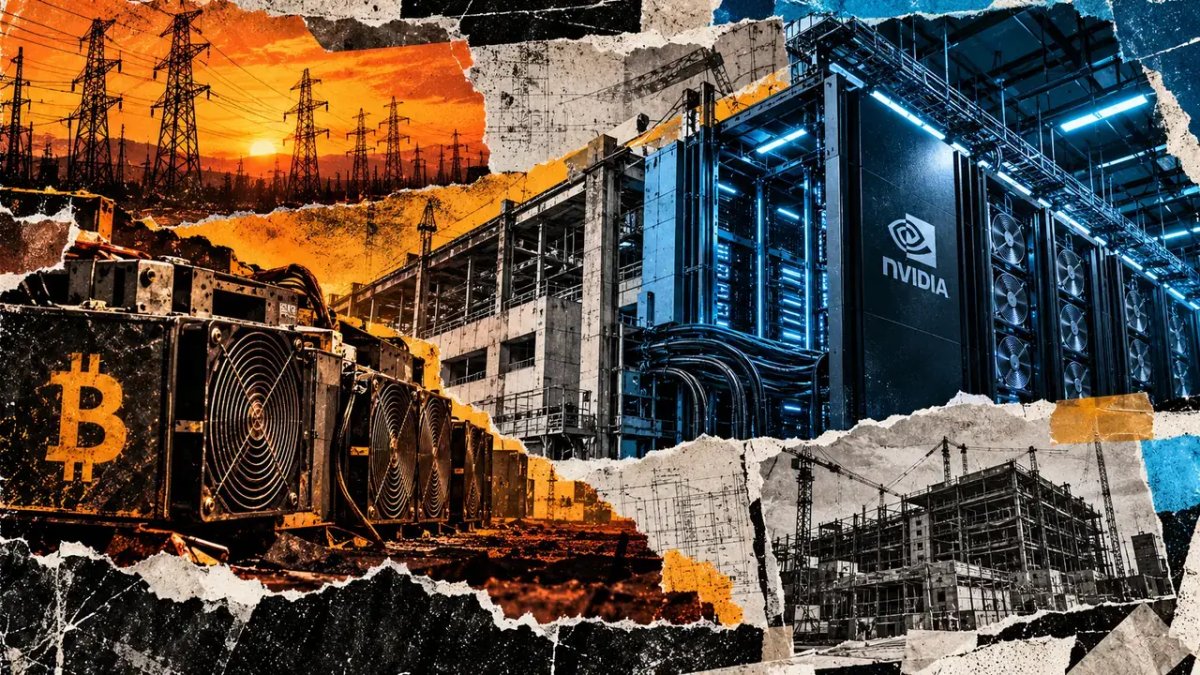
Bitcoin miners spent years securing cheap electricity, building substations, and negotiating the grid connections needed to power their operations. Now AI companies want those connections so badly they're willing to make aging mines valuable real estate.
The ASICs that mine Bitcoin are practically useless for training AI models, but the land, substations, and power agreements around them could spare data-center developers years of waiting.
SWI Group took control of Bitcoin miner Genesis Digital Assets earlier this year and announced an €800 million capital increase on Oct. 12 to expand its AI infrastructure business.
Two weeks later, it launched SWI Compute, disclosing roughly $1 billion in NVIDIA equipment orders and its first customers, with some contracts still being finalized.
As part of the fundraising, Genesis is becoming part of a much bigger bet on selling computing power rather than mining BTC.
It's an irresistible trade on paper: take an industrial property built to consume enormous amounts of electricity and give that electricity to customers willing to pay considerably more for it.
Unfortunately, you can't turn Bitcoin mining facilities into AI data centers just by plugging different computers into the wall. The conversion requires extensive retrofits, cooling that can handle much denser hardware, sophisticated networking, construction financing, and customers willing to commit to the finished product.
Until the facility is operational, the promised revenue is just that: a promise.
Core Scientific's agreements with AI cloud provider CoreWeave show where the money goes. CoreWeave helps fund construction but recovers some of that contribution through rent credits, while Core Scientific borrows billions, builds the facilities, and risks penalties for late delivery.
That's how a mining property can become much more valuable without its owner receiving anything close to that value: electricity draws the customers in, but the contracts determine who gets paid.
Bitcoin mining is an unforgiving business. Operators run specialized computers known as ASICs, competing for block rewards whose value depends on Bitcoin's price and the machines' efficiency relative to the rest of the network.
They require a lot of power to run, regardless of the market, which means companies face the same bills in bull and bear markets. The first wave of public miners were seen as leveraged Bitcoin bets institutions could easily make when access to BTC was hard or impossible.
But the market is a harsh mistress, and these companies now look nothing like leveraged Bitcoin bets. Increased competition and the insatiable hunger for AI have pushed many of them toward becoming data center landlords.
Core Scientific's second-quarter filing puts a price on the old business losing its appeal.
During the first quarter, the company wrote down $266.5 million of mining equipment and infrastructure as Bitcoin prices, mining revenue per unit of computing power, and secondhand equipment values deteriorated.
Of that charge, $151.6 million related to mining machines and $114.9 million to mining infrastructure. Meanwhile, its newer AI colocation business was already producing revenue.
The company's mining operation has been losing money at the gross-profit level while AI hosting earned a positive gross margin.
Mining hardware loses value as it ages, but a working grid connection doesn't. In fact, it can become even more desirable because developers can't just go out and buy one.
Utilities still need to assess transmission capacity, identify upgrades, and determine who pays for them. Having enough cash for GPUs doesn't make those steps go away.
Electricity access became the miners' real prize, but the backlog of proposed projects also makes that access incredibly difficult to value.
In Texas, regulators approved ERCOT's Batch Zero review process in June, while the state ordered an audit of approximately 474 GW of proposed large-load connections.
Electricity already flowing to a facility differs from capacity approved for future use, and both differ from a place in the connection queue. Grouping them under one headline megawatt figure can make a portfolio appear much closer to generating AI revenue than it is.
SWI's June announcement about Genesis described land with more than 1.3 GW of energized and approved connections across 15 facilities. By September, its half-year results described approximately 1.2 GW of secured grid connections.
The disclosures don't reconcile the two figures or provide a site-by-site breakdown separating currently usable capacity from power that requires additional work.
SWI also didn't simply pay a fixed price for those megawatts. Its initial $500 million investment bought about 38.3% of Genesis's equity and rights to 77.2% of the value of certain preferred-share liquidation preferences, which govern claims on proceeds rather than ordinary ownership.
SWI subsequently took control, but dividing that first payment by 1.3 GW would tell us little about what it paid for deliverable power.
Even an agreed valuation of the whole company wouldn't tell us what an operating AI data center costs. Genesis came with a mining business, equipment, land, existing electrical assets, and all kinds of rights to future power.
However, those are just ingredients, and they require a lot of money before they can actually become a profitable AI business.
While Bitcoin mining facilities and data centers might look similar to the untrained eye, they're two very different businesses.
Bitcoin mines are built to run thousands of independent machines that can be switched off when necessary, while AI data centers need sophisticated cooling, high-speed networking, redundant power systems, and much stricter uptime guarantees to keep densely packed GPU clusters operating reliably. So acquiring an existing facility is just a head start.
Data centers consume electricity beyond what their servers use, particularly for cooling and power distribution. At a power usage effectiveness ratio of 1.25, a site drawing 100 MW from its electrical supply would deliver about 80 MW to computing equipment and use the other 20 MW to support the facility.
Comparing that site's 100 MW grid connection with a competitor's 100 MW of usable IT capacity would make two very different properties seem equivalent.
Nvidia's GB300 NVL72 reference architecture describes liquid-cooled racks with 72 GPUs that draw up to 142 kilowatts each.
Delivering the electricity is only one part of supporting them, since cooling, networking, and building design must also meet standards most Bitcoin mines weren't built for.
CoinShares estimated in its September mining report that converting mining infrastructure to AI-grade facilities costs roughly $8 million to $15 million per MW, against $700,000 to $1 million per MW for conventional mining infrastructure.
The order of magnitude explains why owning a powered mining site and owning a completed AI facility command such different valuations.
A review of more than $100 billion in AI deals found that only around 550 MW was billing out of more than 4 GW under contract. HIVE's $350 million AI agreement required an estimated $185 million hardware buildout before most of that revenue could arrive.
Under colocation arrangements, the operator generally provides the buildings, electricity infrastructure, cooling, and other services, while the customer supplies its own computing equipment.
Selling AI computing capacity directly means buying GPUs as well, then finding enough customers to keep them occupied while newer, more efficient hardware makes existing systems less competitive.
Core Scientific earns fees for hosting other companies' machines, while SWI intends to sell computing itself. Both stand to benefit from former mining infrastructure, but their capital requirements and exposure to hardware costs differ greatly.
Related ReadingWe can get a pretty good idea of the math behind these deals from Core Scientific, because some of its converted facilities are already operating and its agreements with CoreWeave spell out where the money goes.