
AI agents are using credit cards. Where does that leave crypto?
AI agents are already using credit cards to transact, raising questions about where crypto fits in the emerging agent economy.

The idea that crypto will become the default payment choice for autonomous AI agents is widespread in the industry. The thesis is that because AI agents can’t open bank accounts and need to make lots of transactions, they will inexorably gravitate to instant, decentralized and low cost crypto payments.
But the credit card industry has no intention of letting that happen.
The Wall Street Journal reported on Nov. 19 that AI agents are already using credit cards to make purchases on consumers’ behalf, and banks and payment companies are racing to accommodate them. Crypto trader and co-host of the 1000x podcast Jonah Van Bourg posted a screenshot, and commented:
“Agents will not use crypto rails. The book is closed on blockchain as a solution, outside of niche back office applications. Its only use cases are sov, privacy, and ledger stuff. Sad.”
But experts argue the jury is still out. Professor emeritus of finance at Marquette University, David Krause, tells Magazine that credit cards offer some advantages, but high costs could be their downfall in certain scenarios.
“Credit cards were built for a world where a human decides to pay, so when an agent pays $0.005 for an API call, the fixed fees on card rails are 50x the transaction itself.”
Stablecoins, he says, make much more sense for “those situations involving micropayments.”
Credit card payments are the default for most human-initiated transactions on the web. So an agent tasked with booking a flight or a hotel room may also default to this type of payment as well.
Related: DeepSeek developing AI agent requiring less human input: Report
“When an agent books your flight or reorders your groceries, it’s acting for a person, at a merchant that already accepts cards, with consumer protections people expect, like chargebacks,” Lewis Nurcombe, chief revenue officer at WalletConnect, tells Magazine.
Visa’s recent paper on the rise of agentic commerce says tokenization can give agents permission to transact without needing to expose the cardholder’s underlying payment details, and spending controls can restrict the purchases they can make.
So when the merchant already accepts cards and has familiar mechanisms for handling disputed transactions, it’s hard to argue the virtues of introducing an entirely new payment system.
But the economics start to change when agents begin paying other machines.
AI agents may create a new economy of machine-to-machine transactions, where agents buy access to a dataset, request computing power, or pay to access a single piece of information. Many of these transactions may only be worth a fraction of a cent and potentially need to occur thousands of times without a human approving each one.
“If an agent wants to pay a few cents for one API call or one piece of data, card fees don’t make sense,” Aitor Argomaniz, chief executive of AI payments company Nevermined, tells Magazine.
That’s because card networks were designed around transactions big enough to absorb fixed processing fees, rather than micro-payments.
Stablecoins offer a different model. Agents can hold funds in a wallet, make payments programmatically and settle transactions onchain without going through a conventional checkout process.
Nurcombe says that stablecoins are most useful “wherever the transaction is too small, too frequent or too global for cards to make sense.”
Protocols like x402 let services request payment as part of an internet interaction. That allows an agent to pay for access to a resource rather than subscribe to a service or manually complete a checkout.
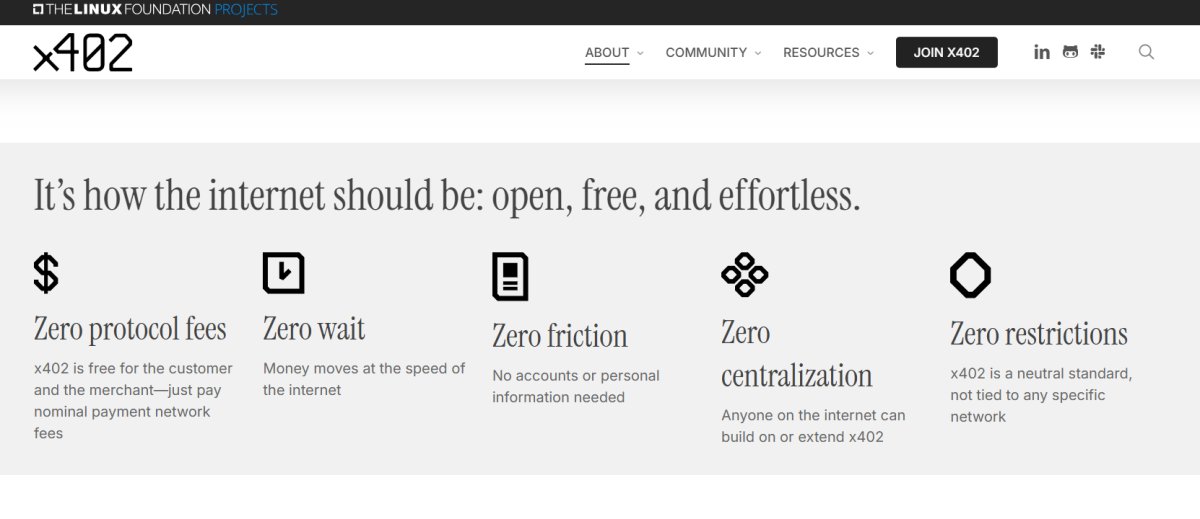
x402 is an open, neutral standard for internet-native payments. Source: x402
Nevermined compared 100 API calls priced at 10 cents each. Using a conventional card via Stripe would not be an option as the payments infrastructure network rejects charges under $0.50. But using stablecoins, the company estimates the same 100 payments would cost around 10 cents in total using Coinbase’s x402 facilitator on Base.
That doesn’t mean crypto payments will automatically win however, as a number of microtransactions could be aggregated into a single card payment. Stablecoin transactions also carry costs related to infrastructure, conversion, custody and liquidity.
The Bank for International Settlements (BIS) found that stablecoin transfers can still incur trading, conversion and withdrawal fees, while limited liquidity between stablecoins and local currencies can add further friction.
In the transition to agentic finance, there’s a more fundamental question to overcome: who is responsible when an agent gets something wrong?